Multifamily Absorption Just Beat New Supply for the First Time in Nearly 5 Years
How to Evaluate a Multifamily Real Estate Investment: A Step-by-Step Guide for Physicians and Accredited Investors
Cereus Real Estate | September 25, 2026
Multifamily Absorption Just Beat New Supply for the First Time in Nearly Five Years: What It Means for Investors
The U.S. multifamily market may finally be entering a new phase.
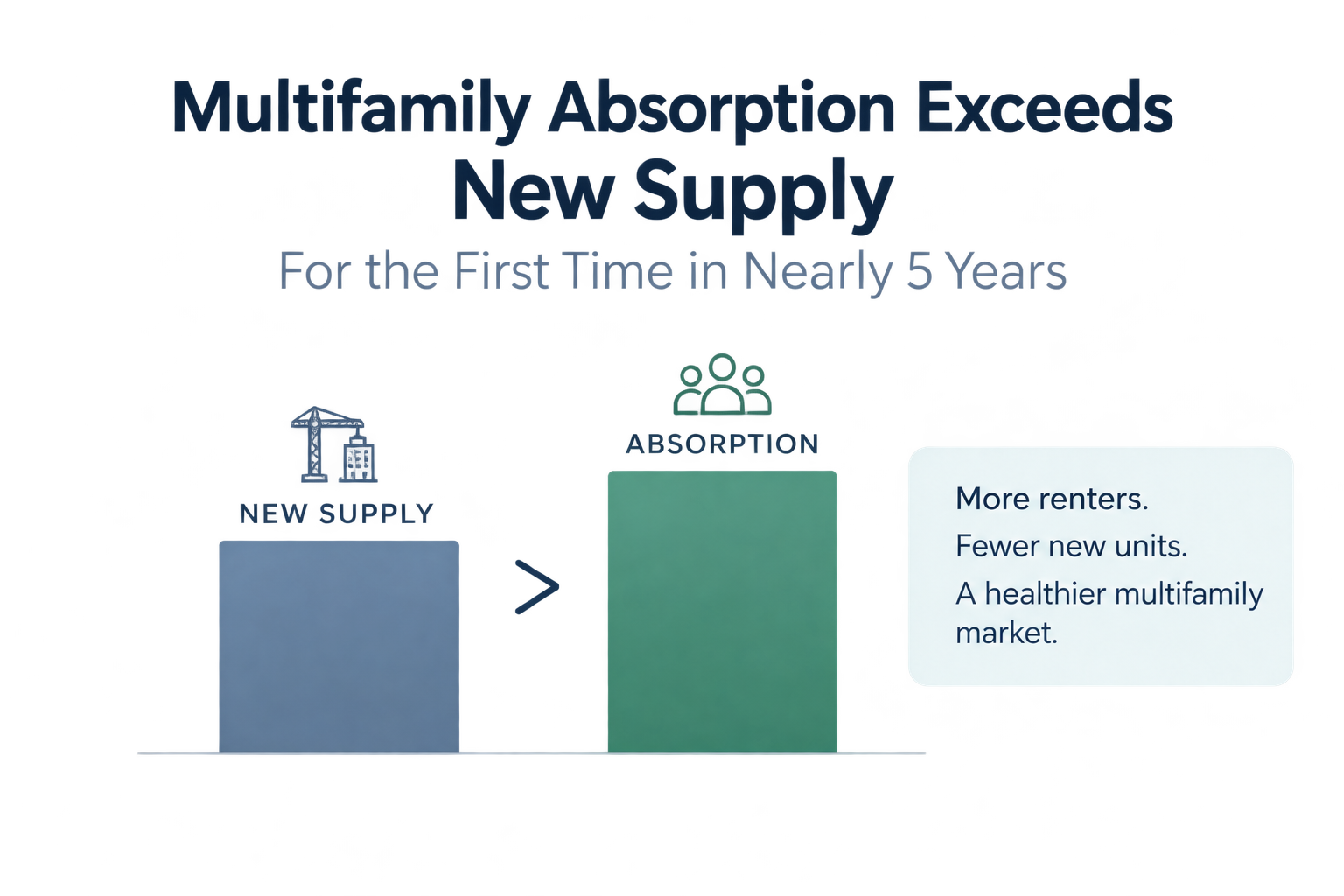
After several years of heavy apartment construction, elevated vacancy, landlord concessions, and muted rent growth, renter demand has reached an important milestone. According to the National Association of REALTORS® (NAR), multifamily absorption exceeded new deliveries in July 2026 for the first time in nearly five years.
That does not mean every apartment market is suddenly strong. Real estate remains highly local, and some regions are still working through excess inventory. But nationally, the relationship between apartment supply and renter demand is becoming more balanced.
For multifamily real estate investors, that shift is worth watching.
What Does Multifamily Absorption Actually Mean?
The term "absorption" can sound technical, but the concept is relatively simple.
Multifamily absorption measures the change in occupied apartment units over a given period.
When more apartments are leased than become vacant, the market records positive absorption. When vacancies increase faster than new leases are signed, absorption is negative.
The important comparison for investors is between absorption and new supply.
Imagine a market receives 10,000 newly constructed apartments during a year. If renters occupy 12,000 more units than they leave during that period, demand has outpaced the number of new homes entering the market.
That is the type of relationship investors are now seeing at the national level.
Why the Shift Is Significant
The apartment sector has spent much of the last several years digesting a large wave of new construction.
Developers responded to strong rental demand and favorable demographic trends by building aggressively. That construction eventually created substantial competition among properties, particularly in markets that experienced rapid population growth.
NAR's earlier 2026 reports showed how significant that imbalance had been. In April, deliveries were still exceeding demand, even though the gap was narrowing. By July, the relationship had reversed nationally.
That transition matters because multifamily performance is heavily influenced by supply and demand.
When too many apartments compete for too few renters, owners may need to offer concessions or hold rents steady to maintain occupancy.
When demand begins absorbing available inventory, those pressures can gradually ease.
The Supply Pipeline Is Changing
One of the biggest reasons behind the improvement is that new multifamily construction has started to slow.
Higher financing costs, more selective lending, elevated development expenses, and changing project economics have made it harder for developers to bring new properties to market at the pace seen during the earlier construction cycle.
NAR reported that multifamily deliveries had already slowed significantly during the first part of 2026.
This creates an important dynamic:
The market does not necessarily need a dramatic surge in demand to improve. It can also improve because the amount of new competition is declining.
That distinction is important for investors evaluating the next stage of the cycle.
Renter Demand Has Remained Resilient
At the same time, the underlying need for rental housing has remained relatively durable.
For many households, purchasing a home remains difficult because of the combined effect of home prices, mortgage costs, taxes, insurance, and other ownership expenses.
That can extend the period during which households remain renters.
Demographic trends also continue to support rental housing demand. Younger adults forming households, workers relocating for employment, and households delaying home purchases can all contribute to sustained apartment demand.
NAR noted earlier in 2026 that multifamily absorption remained above historical norms even while the sector was dealing with elevated supply.
What Could Happen to Rents?
This is where investors should be careful.
Stronger absorption does not automatically mean rents will surge.
A market can experience improving occupancy while owners are still dealing with recently delivered properties, existing concessions, and competition among buildings.
However, as excess inventory is gradually absorbed, landlords may regain some ability to reduce concessions and push rents at a healthier pace.
NAR's September 2026 report describes the current environment as one in which vacancy is easing and rent growth is gradually firming as demand catches up with new supply.
For multifamily owners, even modest improvements can matter.
A property with stronger occupancy and fewer concessions can produce better revenue without requiring dramatic rent increases.
Why Occupancy Matters So Much to Investors
Multifamily investing ultimately comes down to property-level economics.
Higher occupancy generally means more units generating rental income. Lower concessions can improve effective rents. Better operating performance can increase net operating income (NOI).
And NOI is particularly important because it plays a major role in how income-producing real estate is valued.
Consider a property where management improves occupancy while reducing unnecessary expenses. Even without a major increase in advertised rents, the property's financial performance can improve.
That is why experienced investors look beyond headline rent growth.
They examine the entire operating picture.
Not Every Multifamily Market Will Recover at the Same Speed
One of the biggest mistakes investors can make is treating the national multifamily market as a single market.
It isn't.
Apartment fundamentals can vary dramatically between cities, neighborhoods, property classes, and submarkets.
NAR's 2026 research continues to show meaningful differences between markets and property classes. Some oversupplied Sun Belt markets have faced more pressure, while major urban markets and other locations have demonstrated stronger absorption.
That makes market selection particularly important.
Investors should consider factors such as:
Population and household growth
Employment diversity
New apartment construction
Current vacancy
Rent trends
Local economic conditions
Barriers to future development
Neighborhood-level supply and demand
The headline about absorption beating supply is encouraging, but the more important question is:
Where is that improvement actually happening?
What This Could Mean for Multifamily Investors
A healthier supply-demand relationship can create several potential benefits for apartment owners.
Improved Occupancy
As available inventory gets absorbed, properties may have an easier time maintaining or increasing occupancy.
Fewer Concessions
Properties that previously relied on free-rent promotions or other incentives may eventually need fewer concessions as competition declines.
Better Revenue Performance
Improved occupancy and stronger effective rents can contribute to higher property revenue.
Potential NOI Growth
If revenue improves while operating expenses remain controlled, net operating income can benefit.
Greater Visibility for Underwriting
Investors can make better acquisition decisions when they have greater clarity around future supply and expected rental demand.
Of course, none of these outcomes are guaranteed. Property-level execution, financing, location, operating costs, and broader economic conditions still matter.
Why This Matters for Physicians and Accredited Investors
For high-income professionals, investing in real estate is often less about finding the next hot market and more about building a diversified financial strategy.
Physicians, in particular, frequently have substantial income tied to active clinical work. Building assets outside of earned income can provide another potential component of a long-term wealth strategy.
Multifamily real estate may offer investors exposure to rental income and potential appreciation while allowing them to participate through passive investment structures rather than managing individual properties themselves.
Tax treatment can also be an important consideration, although the benefits depend on the specific investment structure and an investor's individual circumstances. Investors should consult their tax and financial professionals before making decisions based on potential tax advantages.
How Cereus Real Estate Looks at the Opportunity
At Cereus Real Estate, we believe market headlines are only the beginning of the investment analysis.
A national statistic can tell us that multifamily fundamentals are changing, but it does not tell us whether a particular property is attractive.
That requires a deeper look.
We evaluate factors such as local supply, renter demand, economic conditions, property performance, operating assumptions, and the long-term outlook for the market.
The objective is not simply to buy an apartment property because the broader multifamily sector is improving.
The objective is to identify opportunities where the property, market, numbers, and investment strategy align.
What Investors Should Watch Next
The next stage of the multifamily cycle will be shaped by several variables.
Investors should keep an eye on the pace of new apartment deliveries, changes in vacancy, rent growth, household formation, construction activity, and the cost of financing.
One especially important question is whether the recent improvement continues.
NAR's September 2026 report suggests the sector is beginning to work through excess inventory as demand catches up with new deliveries.
If that trend persists, multifamily investors could enter a period in which improving fundamentals provide a stronger foundation for property performance.
The Bigger Picture
The most important takeaway is not simply that absorption exceeded new supply in July.
It is what that change represents.
For several years, multifamily investors have operated in an environment where new construction created significant competition for renters. Now, that supply wave is beginning to lose momentum while demand remains present.
That combination can change the investment landscape.
It may take time for the improvement to show up consistently in rents, property values, and transaction activity. Markets will continue to behave differently, and investors still need to underwrite each opportunity carefully.
But the shift in supply and demand gives investors another reason to pay close attention to multifamily real estate.
At Cereus Real Estate, we will continue watching these fundamentals and looking for opportunities where disciplined underwriting, strong markets, and long-term investment strategies come together.
Frequently Asked Questions
What is multifamily absorption?
Multifamily absorption refers to the net change in occupied apartment units over a specific period. It helps investors understand how quickly renter demand is taking up available inventory.
Why is absorption exceeding new supply important?
When apartments are being absorbed faster than new units are delivered, excess inventory can begin to decline. Over time, that can support occupancy and potentially improve pricing conditions.
Does higher absorption guarantee higher rents?
No. Rent growth depends on several factors, including local competition, vacancy, concessions, employment, household growth, and the amount of inventory still being absorbed.
Is every multifamily market improving?
No. Multifamily conditions vary considerably by geography and property class. Some markets continue to deal with substantial new supply, while others are seeing stronger demand relative to deliveries.
Why do investors pay attention to NOI?
Net operating income is a core measure of a property's operating performance. Changes in rental revenue, occupancy, concessions, and expenses can directly affect NOI and therefore the economics of an investment.
How does Cereus Real Estate evaluate multifamily opportunities?
Cereus Real Estate considers market fundamentals, supply and demand, economic conditions, property-level performance, operating assumptions, and long-term investment objectives when evaluating opportunities.
Final Thoughts
The multifamily market is not suddenly risk-free, but the latest supply-and-demand data points to an important change.
After years of new apartment deliveries exceeding absorption, NAR reports that the relationship reversed in July 2026.
For investors, that makes the current environment worth studying - not because every property will benefit equally, but because changing fundamentals can create a different set of opportunities.
The next phase of multifamily investing may be less about surviving excess supply and more about identifying the markets and assets positioned to benefit as that inventory is absorbed.
Daniel Shin, MD