
Multifamily Real Estate vs. Stock Market Investing
Multifamily Real Estate vs. Stock Market Investing: Which Is Better for Building Long-Term Wealth?
Cereus Real Estate | 21 July 2026
For decades, investors have debated the best way to build long-term wealth: real estate or the stock market?
Both can play an important role in a diversified investment strategy. Stocks offer liquidity, accessibility, and the potential for long-term capital appreciation. Real estate, particularly multifamily real estate investing, can provide investors with opportunities for recurring cash flow, potential tax advantages, and long-term appreciation.
For physicians and other high-income professionals, the question is often more specific:
How can I build wealth without spending more of my time managing investments?
This is where passive real estate investing and real estate syndications may become especially attractive.
Rather than choosing between real estate and stocks entirely, many investors consider how each asset class fits into their broader financial goals. Understanding the differences can help you make more informed decisions about diversification, passive income, risk, and long-term wealth building.
In this guide, we'll compare multifamily real estate vs. stock market investing, explore potential differences in returns and tax treatment, and explain why some physicians and accredited investors consider multifamily real estate as part of their strategy for pursuing greater financial freedom.
Multifamily Real Estate vs. Stock Market Investing: An Overview
At a high level, both stocks and real estate are investment vehicles designed to help investors grow capital over time.
The major difference is what you own and how returns are generated.
When you invest in stocks, you typically purchase shares of publicly traded companies. Your potential returns may come from:
Stock price appreciation
Dividend income
Reinvestment of dividends
Growth in the underlying company
With multifamily real estate, investors participate in the ownership of apartment communities and other residential properties. Returns may come from:
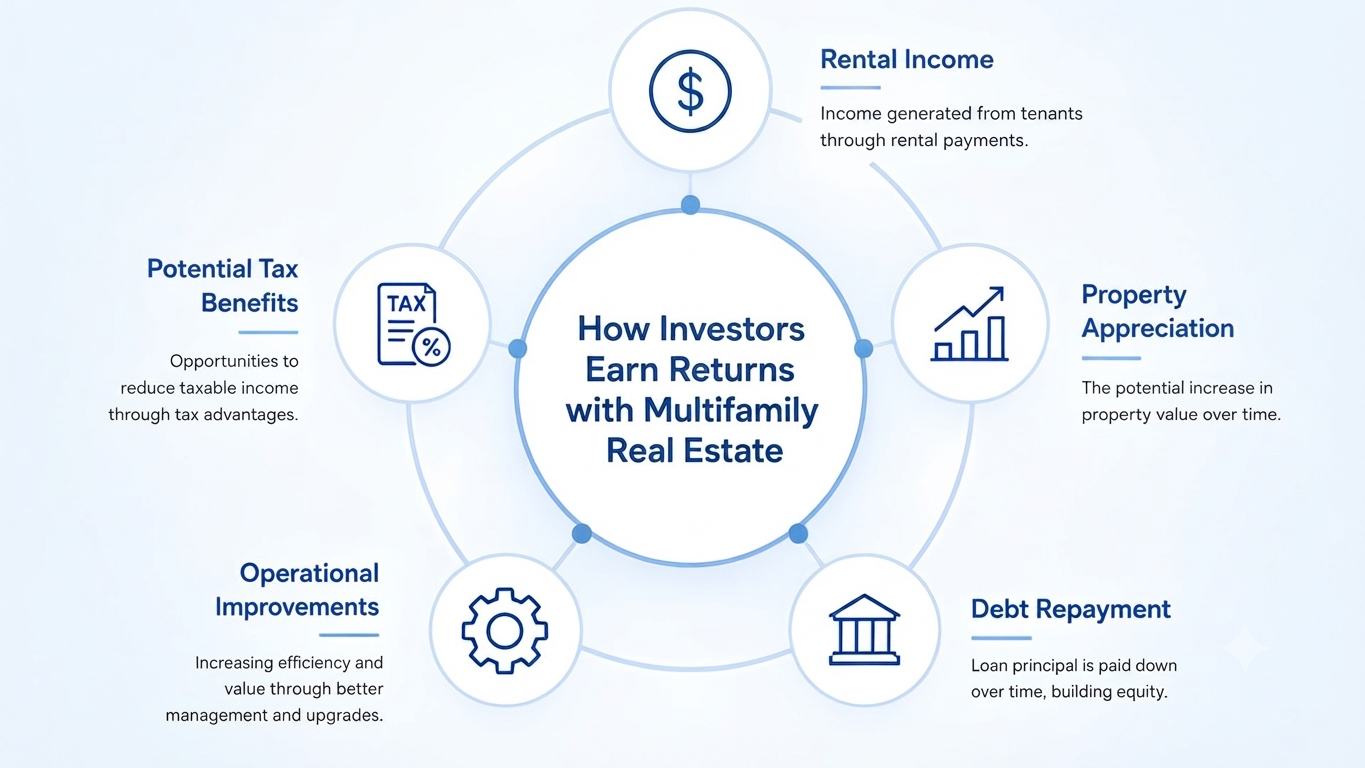
For investors who want to participate in real estate without becoming a landlord, real estate syndication can provide another option.
In a syndication, multiple investors pool capital to acquire an investment property or portfolio. A professional sponsor or investment team manages the acquisition and operations, while investors participate economically according to the terms of the offering.
This approach can provide exposure to real estate while allowing investors to remain focused on their careers, businesses, and families.
What Is Multifamily Real Estate Investing?
Multifamily real estate investing involves investing in properties designed to house multiple residential households.
Examples include:
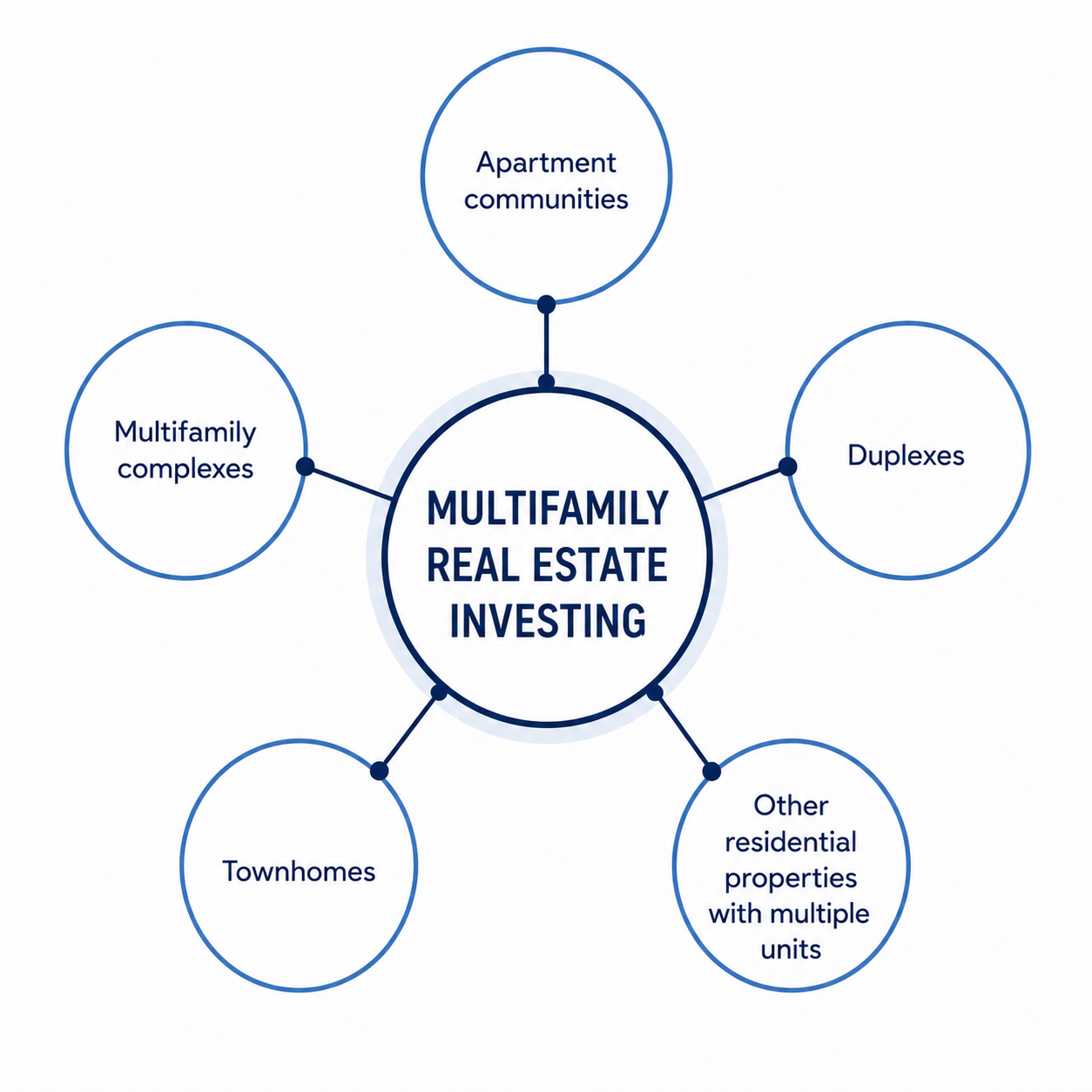
The investment thesis is often based on the ability to generate income from tenants while potentially increasing the value of the property over time.
For example, a multifamily property may generate revenue through monthly rents. If the investment team can improve occupancy, control expenses, renovate units, or otherwise improve operations, the property's financial performance may increase.
That can potentially contribute to long-term property value.
However, real estate investing is not risk-free. Property values can decline, operating expenses can rise, vacancies can increase, and financing conditions can change.
The key is understanding that real estate investing is an active business at the property level - even when the investor's role is passive.
What Is Passive Real Estate Investing?
Passive real estate investing allows investors to gain exposure to real estate without directly managing properties themselves.
Instead of:
Finding tenants
Collecting rent
Handling maintenance
Managing employees
Negotiating leases
Coordinating property operations
A passive investor may invest through a professional sponsor or syndication structure.
This can be particularly appealing to busy professionals.
For physicians, for example, the demands of practicing medicine can make direct property management difficult. A physician may have limited time to evaluate properties, manage tenants, or oversee day-to-day operations.
Passive real estate investing may allow investors to participate in real estate while maintaining their primary focus on their careers and personal priorities.
This is one reason passive income for doctors has become an increasingly discussed topic among physicians exploring alternative investment strategies.
Real Estate Syndication Explained
One of the most common ways investors participate in passive real estate investing is through real estate syndication.
So, what is real estate syndication?
A real estate syndication is an investment structure where multiple investors pool their capital to invest in a larger real estate opportunity.
The process typically involves several parties.
The Sponsor
The sponsor, sometimes called the general partner or managing member, is responsible for managing the investment strategy.
Depending on the structure, the sponsor may:
Identify potential properties
Conduct due diligence
Arrange financing
Acquire the property
Oversee operations
Manage the business plan
Coordinate property management
Execute the eventual exit strategy
The Passive Investor
Passive investors contribute capital to the investment and typically do not manage the day-to-day property operations.
Instead, investors rely on the sponsor and operating team to execute the business plan.
The Investment
The pooled capital may be used to acquire or develop a multifamily property or portfolio.
Depending on the offering, investors may potentially receive distributions from property-level cash flow and participate in profits when the property is refinanced or sold.
However, every investment is different. Returns are not guaranteed, and investors should carefully review offering documents, risks, fees, sponsor experience, and projected returns before investing.
Real Estate vs. Stock Market Returns: How Do They Compare?
One of the most common questions investors ask is:
Which generates better returns - real estate or stocks?
The honest answer is that there is no universal winner.
Historical performance varies depending on the time period, market conditions, property type, leverage, geographic location, stock selection, and investment strategy.
The stock market has historically provided strong long-term growth potential, but investors must be prepared for market volatility.
Real estate may offer a combination of income and appreciation, but it comes with risks related to property operations, financing, vacancies, insurance, taxes, and local market conditions.
When comparing real estate vs. stock market returns, investors should look beyond a single return metric.
Consider:
Cash flow
Appreciation
Total return
Volatility
Liquidity
Tax treatment
Leverage
Time commitment
Diversification
Investment horizon
A stock portfolio may be easier to buy and sell, while a private real estate investment may require investors to commit capital for several years.
On the other hand, real estate can potentially provide income from operations while offering investors exposure to a physical asset.
The best choice depends on the investor's objectives, risk tolerance, liquidity needs, and overall financial plan.
Multifamily Real Estate vs. Stocks: Key Differences
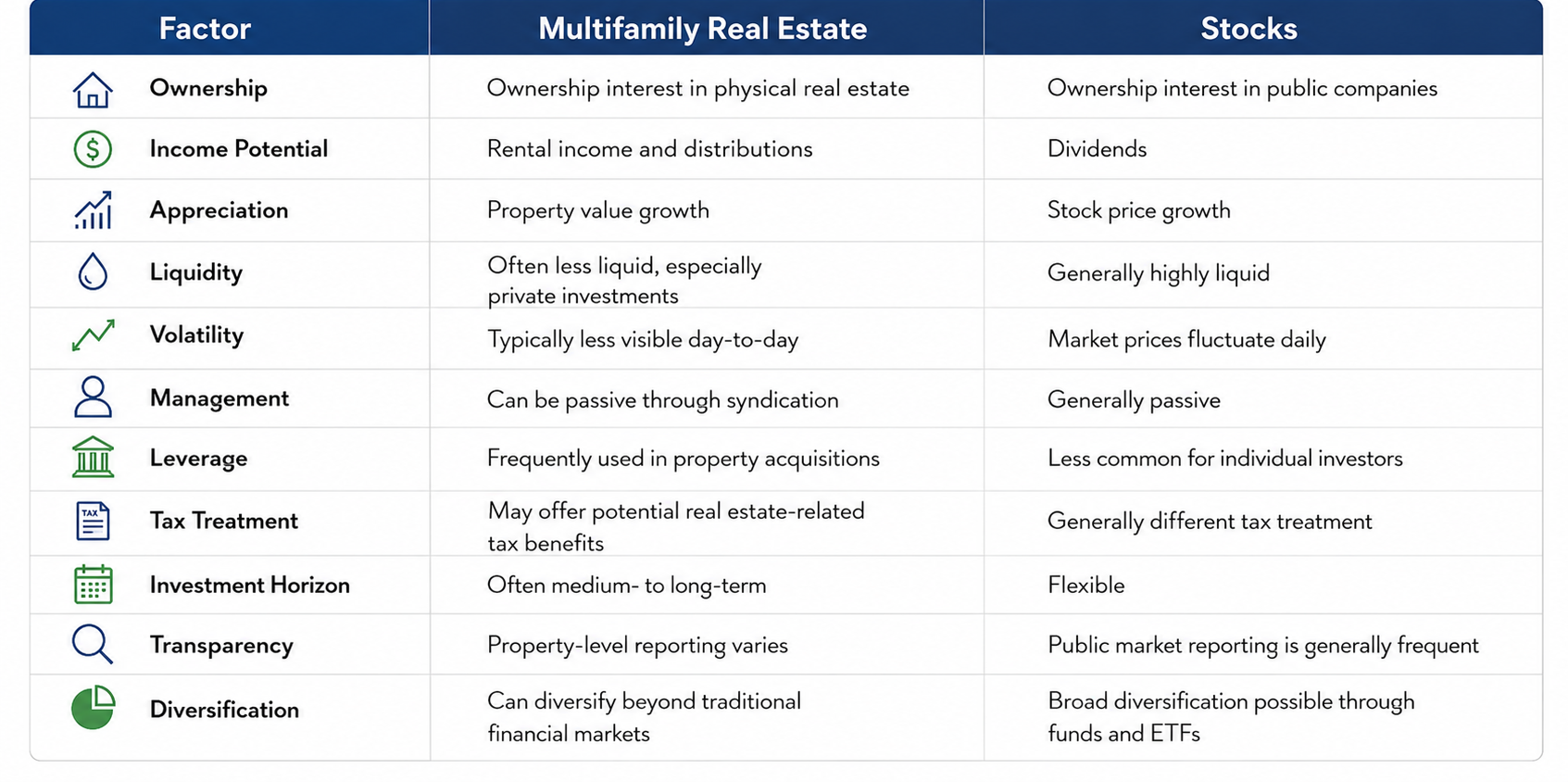
The table highlights an important point:
These investments do not have to be competitors.
For many investors, the question isn't whether to invest in stocks or real estate. It may be whether owning both can create a more diversified portfolio.
Why Physicians Consider Multifamily Real Estate Investing
Physicians often have a unique financial profile.
They may have:
High earning potential
Significant professional responsibilities
Limited time
Student loan obligations
High tax exposure
A desire to build wealth outside of clinical income
For some doctors, earning more money isn't necessarily the ultimate goal.
The bigger goal may be freedom.
Freedom to work fewer hours.
Freedom to spend more time with family.
Freedom to make career decisions based on personal priorities rather than financial necessity.
This is where the concept of physician financial freedom becomes important.
Your income from medicine may be substantial, but if your wealth depends entirely on continuing to work, your financial independence may still be limited.
Investing can potentially help create additional sources of income and long-term wealth.
For physicians exploring passive income strategies for doctors, multifamily real estate may be one potential component of a broader investment strategy.
Passive Income for Doctors: Why Real Estate May Be Attractive
Many physicians have demanding careers.
The challenge is not necessarily finding another way to make money.
The challenge is finding an investment strategy that does not require another full-time job.
Directly owning rental properties can be rewarding, but it can also require significant time and attention.
Passive real estate investing offers a different approach.
Through a real estate syndication, a physician may be able to invest in larger properties alongside other investors while a professional team handles the operational responsibilities.
Potential benefits may include:
Exposure to real estate
Potential cash flow
Potential long-term appreciation
Professional property management
Potential tax advantages
Portfolio diversification
Of course, passive does not mean risk-free.
Investors should understand that private real estate investments can involve significant risks, including loss of principal, illiquidity, financing risk, market risk, and operational risk.
The goal is not to eliminate risk.
The goal is to understand the risks and determine whether an investment fits your financial objectives.
Multifamily Investing for Beginners: What Should You Know?
If you're new to multifamily investing, it can be helpful to understand the basic components of a real estate investment before committing capital.
1. Location
Real estate is highly dependent on location.
Investors often consider factors such as:
Population growth
Employment growth
Household formation
Rental demand
New construction
Local economic conditions
2. Property
The physical asset matters.
Investors may evaluate:
Property age
Unit count
Occupancy
Physical condition
Renovation needs
Competitive position
3. Financials
Investors should review the property's historical and projected financial performance.
Important metrics may include:
Revenue
Operating expenses
Net operating income
Debt service
Occupancy
Cash flow
4. Sponsor
In a passive investment, the sponsor is extremely important.
Investors may evaluate:
Experience
Track record
Investment strategy
Communication
Transparency
Alignment of interests
5. Investment Structure
Understand how the investment works.
Review:
Minimum investment
Fees
Distribution structure
Preferred returns, if applicable
Profit-sharing structure
Investment timeline
Exit strategy
6. Risk
Every investment has risk.
Investors should understand what could cause the investment to underperform and what assumptions are being made in the financial projections.
How Accredited Investors Build Wealth
Many private real estate opportunities are available only to investors who meet specific qualification requirements.
This is where an accredited investor guide can be useful.
Accredited investor standards can vary depending on the applicable regulations and offering structure. Investors should review the current requirements and consult qualified legal or financial professionals when determining eligibility.
For investors who qualify, private real estate opportunities may provide access to investments that are not available through traditional public markets.
This can include:
Multifamily properties
Medical office buildings
Industrial real estate
Self-storage
Private equity real estate
Development projects
For physician investors building generational wealth, the potential value of private real estate may extend beyond current cash flow.
The long-term objective may be to build a diversified portfolio of assets that can potentially generate income, appreciate over time, and contribute to a broader family wealth strategy.
Which Is Better: Multifamily Real Estate or Stocks?
There is no single answer.
For investors seeking:
Liquidity: Stocks may have an advantage.
Daily transparency: Public markets provide frequent pricing.
Potential passive income: Both stocks and real estate can potentially generate income.
Physical asset exposure: Real estate provides direct or indirect ownership exposure to property.
Portfolio diversification: Both can play a role.
Professional management: Both can be passive, depending on how you invest.
Long-term wealth building: Both have historically been used by investors to pursue long-term financial growth.
The right question may not be:
"Should I invest in stocks or real estate?"
Instead, consider asking:
"How can I build a diversified portfolio that aligns with my goals, timeline, risk tolerance, and need for liquidity?"
For some investors, the answer may include both.
The Role of Real Estate in a Diversified Investment Strategy
Diversification is about more than owning multiple investments.
It can also mean owning different types of assets with different risk and return characteristics.
A diversified portfolio may include:
Public equities
Bonds
Cash
Private real estate
Multifamily investments
Other alternative investments
The goal is to avoid depending entirely on one asset class or one source of income.
For physicians, this can be especially relevant.
Your medical career may be your largest source of income.
Your investment portfolio can potentially become another engine for wealth creation.
Over time, the goal may be to create enough financial flexibility that your lifestyle is not entirely dependent on your clinical income.
That's the foundation of physician financial freedom.
Final Thoughts: Choosing the Right Investment Strategy
The debate between multifamily real estate vs. stock market investing does not have to end with one clear winner.
Both investment strategies have strengths and weaknesses.
Stocks offer liquidity, accessibility, and broad diversification.
Multifamily real estate can provide exposure to physical assets, rental income, and potential appreciation.
For investors who want real estate exposure without managing properties directly, passive real estate investing through real estate syndication may be worth exploring.
For physicians, the potential benefit extends beyond investment returns.
It may be about building a financial foundation that gives you more choices.
More flexibility.
More time.
More control.
And ultimately, more freedom to decide what your life looks like.
At Cereus Real Estate, we believe that physicians and accredited investors should have access to investment opportunities designed around long-term wealth building - not simply chasing the next market trend.
Whether you're exploring multifamily investing for beginners, researching passive income strategies for doctors, or looking for ways to diversify your portfolio, the first step is education.
Understand the investment.
Understand the risks.
Understand the sponsor.
And make decisions based on your own financial goals and circumstances.
The goal isn't simply to build wealth. It's to build the financial freedom to use that wealth on your terms.
Disclaimer: This content is for educational and informational purposes only and should not be considered financial, investment, legal, or tax advice. Past performance is not indicative of future results. All investments involve risk, including the possible loss of principal. Private real estate investments may be illiquid and are generally suitable only for qualified investors. Consult your financial, legal, and tax advisors before making investment decisions.
Daniel Shin, MD