
Real Estate Syndication 101: How the Structure Actually Works
Real Estate Syndication 101: How the Structure Actually Works
Cereus Real Estate | 30 July 2026
For many physicians, investing in real estate sounds appealing in theory but difficult in practice.
You may understand the potential benefits of owning real estate, but finding properties, arranging financing, managing tenants, and dealing with day-to-day operations can feel like taking on another job.
That is where real estate syndication comes in.
A syndication can give investors the opportunity to participate in larger real estate investments without personally managing the property. For physicians and other busy professionals, this approach can be an attractive way to explore passive real estate investing while continuing to focus on a demanding career.
But before investing, it is important to understand exactly how the structure works.
What is real estate syndication? Who is responsible for managing the property? What does a General Partner do? What does a Limited Partner do? How are profits divided?
Let's break down the syndication structure, explain GP vs LP real estate, and look at what physicians should understand before investing in a real estate syndication.
What Is Real Estate Syndication?
So, what is real estate syndication in simple terms?
Real estate syndication is a structure that allows multiple investors to pool their capital and invest in a real estate property or portfolio together.
Instead of one investor purchasing and managing an entire apartment community, a group of investors contributes capital to a shared investment. A sponsor or investment team typically identifies the opportunity, arranges financing, manages the business plan, and oversees the property.
The investors participate according to the terms established in the investment documents.
This approach is commonly used for larger investments such as:
Multifamily apartment communities
Build-to-rent communities
Medical office buildings
Industrial properties
Self-storage facilities
Other commercial real estate
For physicians, this structure can be particularly interesting because it may provide access to passive real estate investing for physicians without requiring them to become full-time landlords.
The key word, however, is passive.
Passive investing does not mean risk-free investing. Investors still have financial exposure to the property's performance, the market, the financing structure, and the sponsor's ability to execute the investment strategy.
Understanding how the deal is structured is therefore one of the most important steps before investing.
Why Are Physicians Interested in Real Estate Syndication?
Physicians often have a unique set of financial challenges.
A demanding career can provide a strong income, but it can also leave little time for managing investments directly. At the same time, many physicians are looking for ways to diversify beyond traditional investments such as stocks and bonds.
This is one reason real estate syndication for doctors has become an increasingly relevant topic.
A physician may want exposure to real estate but may not have the time to:
Search for investment properties
Analyse potential acquisitions
Negotiate purchase agreements
Arrange financing
Manage tenants
Handle maintenance
Oversee renovations
Monitor property operations
A syndication shifts much of that operational responsibility to the sponsor and investment team.
The physician investor typically contributes capital and receives an ownership interest in the investment, while the sponsor handles the day-to-day execution.
For investors exploring multifamily real estate investing for physicians, this can provide a way to participate in larger properties while maintaining a busy professional and personal schedule.
Of course, every investment is different. The sponsor, property, market, financing, fees, investment timeline, and legal structure should all be evaluated before committing capital.
Syndication Structure Explained: Who Is Involved?
A simple way to understand syndication structure explained is to think of it as a partnership between two primary groups.
The General Partner (GP)
The GP, often referred to as the sponsor, is typically responsible for managing the investment.
The Limited Partners (LPs)
The LPs are generally passive investors

In simple terms, the GP is usually responsible for making the investment happen.
This is why understanding what is a sponsor in real estate syndication is so important.
The sponsor is not simply the person who finds a property. The sponsor is often responsible for executing the entire investment strategy.
For example, imagine a sponsor acquires an apartment community with a value-add strategy.
The business plan may involve renovating outdated units, improving property management, increasing occupancy, and controlling expenses.
The sponsor's job is to coordinate those efforts and work toward the goals outlined in the investment plan.
That requires experience, resources, market knowledge, and disciplined execution.
For investors, evaluating the sponsor can be just as important as evaluating the property itself.
What Does a Limited Partner Do?
The Limited Partner, or LP, is generally the passive investor in a syndication.
Rather than managing the property directly, the LP contributes capital and receives an ownership interest according to the terms of the investment.
The LP typically does not handle day-to-day responsibilities such as:
Collecting rent
Managing tenants
Hiring contractors
Handling maintenance
Negotiating leases
Managing property employees
Instead, the LP relies on the GP and its operating partners to manage the investment.
This is one of the reasons passive real estate investing for physicians can be appealing.
A physician may be able to participate in a real estate investment without personally dealing with the operational demands of owning and managing an apartment community.
However, being a passive investor does not mean being an uninformed investor.
LPs should still understand the investment strategy, risks, fees, projected timeline, distribution structure, and sponsor track record before investing.
GP vs LP Real Estate: What's the Difference?
Understanding GP vs LP real estate is essential for anyone considering a syndication.
The simplest distinction is this:
The GP generally manages the investment. The LP generally provides capital and participates as a passive investor.
Here's a simplified comparison:
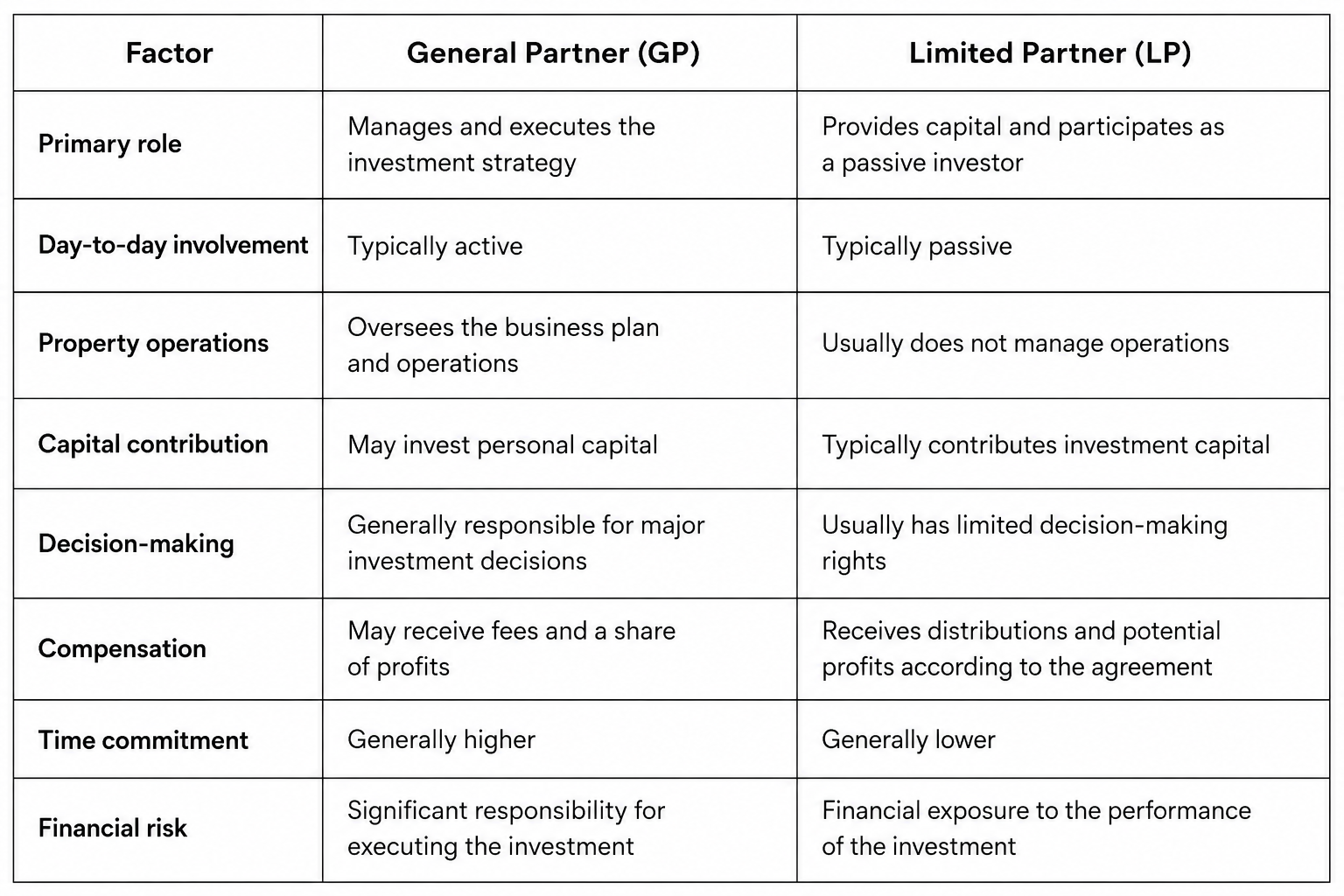
The exact structure varies from deal to deal.
Some GPs may invest significant personal capital alongside LP investors. Others may have different fee arrangements or profit-sharing structures.
The important point is to understand the specific terms of the investment you are considering rather than assuming every syndication works the same way.
How Does a Real Estate Syndication Make Money?
There are generally two primary ways investors may benefit from a real estate syndication.
1. Operating Cash Flow
A property generates income through rent and other sources of revenue.
That income is used to pay expenses such as:
Property management
Repairs and maintenance
Insurance
Property taxes
Utilities
Debt service
Capital expenditures
If the property generates distributable cash flow, investors may receive distributions according to the terms of the investment.
The amount and frequency of those distributions depend on the property's actual performance and the investment agreement.
They are not guaranteed.
2. Appreciation and Sale Proceeds
The second potential source of returns is the increase in the property's value.
A sponsor may purchase a property with the expectation that improvements to the asset or its operations will increase its value over time.
For example, a multifamily investment may involve:
Renovating units
Improving occupancy
Increasing rental income
Reducing operating expenses
Improving property management
If the strategy is successful, the property's net operating income may increase, potentially increasing its value.
The property may eventually be sold or refinanced.
If the investment generates a profit, the proceeds are distributed according to the deal's specific structure.
However, appreciation is never guaranteed. Property values can decline, markets can change, and investment strategies can underperform expectations.
What Is a Real Estate Waterfall?
One term investors will often encounter when reviewing a syndication is the waterfall.
A waterfall describes how cash flow and profits are allocated between the LP investors and the GP.
Think of it as a set of rules that determines where the money goes as an investment generates returns.
For example, a deal might establish:
A return of invested capital
A preferred return to LP investors
A profit split between LPs and the GP
Additional profit-sharing tiers if certain performance targets are achieved
The exact structure depends on the investment.
Some deals may have a relatively simple arrangement, while others may include multiple performance hurdles.
This is why investors should not look only at a projected return.
It is equally important to understand how that return is calculated and how profits are divided.
A projected 15% return can mean very different things depending on the investment structure, fees, timing, and assumptions behind the projection.
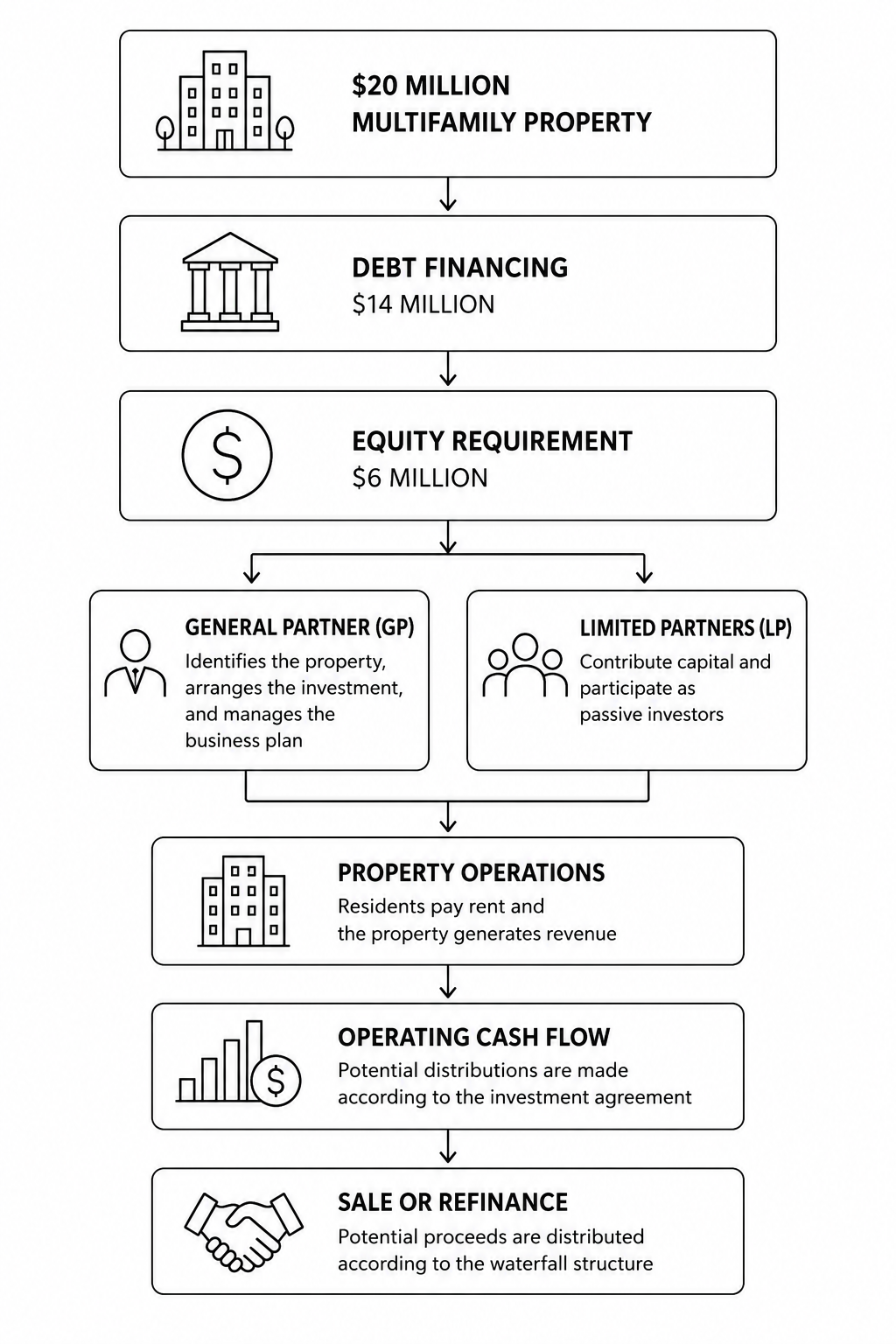
A Simple Example of How a Syndication Works
Let's consider a simplified example.
How Much Do You Need to Invest in a Real Estate Syndication?
One common question from new investors is, how much do you need to invest in a real estate syndication?
There is no universal minimum.
The minimum investment depends on the specific sponsor, offering, property, and investment structure.
Some private real estate offerings may have minimums of $25,000, while others may require $50,000, $100,000, or more.
For example, an accredited investor real estate syndication may establish a minimum investment based on the amount of capital required to acquire the property and the number of investors the sponsor intends to bring into the deal.
Investors should also understand that private real estate investments are often less liquid than publicly traded investments.
In many cases, you may not be able to simply sell your investment whenever you choose.
This makes it important to invest only capital that you can reasonably commit for the expected investment period.
Who Can Invest in a Real Estate Syndication?
Many private real estate syndications are offered to accredited investors, although the eligibility requirements depend on the specific offering and applicable securities regulations.
An accredited investor real estate syndication may be structured under a private securities exemption, with specific requirements governing who can participate and how the investment can be marketed.
If you're a physician considering a syndication, don't assume that a high income automatically makes you eligible.
Accreditation rules can depend on factors such as income, net worth, or certain professional qualifications.
Investors should review the specific eligibility requirements for the offering and consult qualified legal or financial professionals when appropriate.
How to Evaluate a Real Estate Syndication Deal
Understanding how to evaluate a real estate syndication deal requires looking beyond the projected returns.
Before investing, consider these five areas.
1. Evaluate the Sponsor
Start with the people managing the investment.
Look at:
Experience
Track record
Experience with similar properties
Market knowledge
Communication practices
Previous investment performance
Past performance does not guarantee future results, but understanding the sponsor's background can help you assess the team's ability to execute its strategy.
2. Understand the Property
Know what you're investing in.
Ask:
What type of property is it?
Where is it located?
What is the current occupancy?
How old is the property?
What improvements are planned?
Who are the tenants?
What is the expected investment period?
A strong sponsor cannot eliminate property-level risks.
The asset itself matters.
3. Study the Market
Real estate is highly local.
Look at factors such as:
Population growth
Employment
Housing demand
New construction
Rental growth
Supply and demand
Local economic trends
A property can have a strong business plan, but changing market conditions can still affect the outcome.
4. Understand the Financial Structure
Don't focus only on the projected IRR or equity multiple.
Understand:
Preferred return
Profit split
Sponsor fees
Debt structure
Loan terms
Distribution policy
Expected hold period
Exit assumptions
The details can have a significant impact on your actual investment experience.
5. Understand the Risks
Every investment carries risk.
Real estate syndication risks may include:
Declining property values
Higher interest rates
Rising insurance costs
Unexpected repairs
Higher vacancies
Construction delays
Refinancing risk
Economic downturns
Sponsor execution risk
Illiquidity
A good investment process isn't about eliminating every risk.
It's about understanding the risks you're taking and deciding whether they fit your financial goals and risk tolerance.
Why a Physician-Led Real Estate Fund May Appeal to Doctors
For physicians exploring real estate, the sponsor-investor relationship can be particularly important.
A physician-led real estate fund may offer an investment platform built around an understanding of the financial priorities and time constraints that physicians often face.
Physicians may have high earning potential but limited time.
They may also be balancing:
Student loan obligations
Practice ownership
Family responsibilities
Retirement planning
Tax considerations
Long-term wealth creation
A physician-focused approach to real estate investing may therefore emphasise education, transparency, and long-term investment planning.
However, investors should still evaluate every opportunity independently.
The fact that an investment is physician-led does not automatically make it a good investment.
The property, sponsor, market, financial assumptions, fees, and risks still need to make sense.
Is Real Estate Syndication Right for You?
Real estate syndication can be an interesting option for investors who want exposure to larger properties without taking on the responsibilities of direct property management.
For busy professionals, passive real estate investing for physicians may provide a way to participate in multifamily and other real estate opportunities while maintaining their focus on their careers and families.
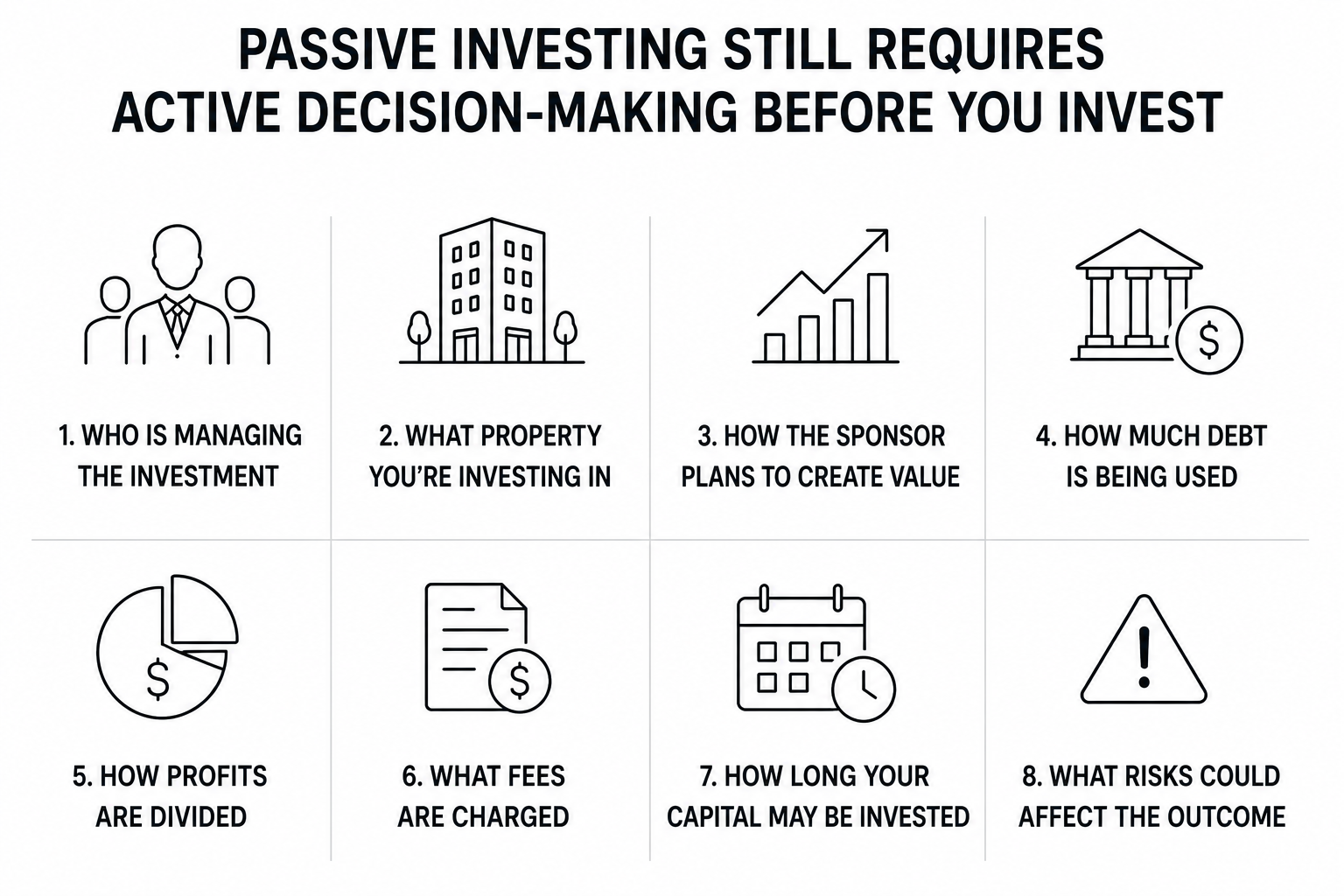
The goal isn't simply to find an investment with the highest projected return.
The goal is to understand the investment well enough to determine whether it fits your overall financial strategy.
Final Thoughts: Understanding the Structure Before You Invest
So, what is real estate syndication?
At its core, it is a way for multiple investors to pool their capital and participate in real estate investments that may be difficult to purchase individually.
The syndication structure explained in simple terms typically involves a GP and LP relationship.
The General Partner manages the investment and executes the business plan.
The Limited Partners typically provide capital and participate as passive investors.
Understanding GP vs LP real estate is an important first step, but it's only the beginning.
If you're a physician considering real estate syndication, take the time to understand the sponsor, property, market, financial structure, fees, and risks.
Ask questions.
Read the offering documents.
Understand how the waterfall works.
And don't invest based solely on projected returns.
For physicians and other accredited investors, real estate syndication may offer a path to participate in larger multifamily investments without becoming a full-time landlord. But the right investment is ultimately the one that aligns with your goals, risk tolerance, liquidity needs, and overall financial plan.
The more you understand how the structure works, the better prepared you are to make informed investment decisions.
Disclaimer: This article is for educational and informational purposes only and should not be considered investment, legal, or tax advice. Private real estate investments involve risk, including the potential loss of principal and limited liquidity. Projected returns are not guaranteed. Investors should conduct their own due diligence and consult qualified financial, legal, and tax professionals before making investment decisions.
Daniel Shin, MD