What Is a 1031 Exchange and Can It Be Used with Real Estate Syndications?
What Is a 1031 Exchange and Can It Be Used with Real Estate Syndications?
Cereus Real Estate | August 24, 2026
For many physicians and high-income professionals, selling an investment property often comes with one unwelcome surprise: capital gains taxes.
A 1031 exchange is one of the most powerful wealth-building strategies in real estate because it allows investors to defer those taxes by reinvesting into another qualifying property. But what happens if your goal is passive real estate investing instead of managing another rental yourself? Can you use a 1031 exchange to invest in a multifamily real estate syndication?
The short answer is usually not directly but there are important exceptions.
This guide explains how 1031 exchanges work, why traditional syndications typically don't qualify, and the alternatives sophisticated investors often consider.
What Is a 1031 Exchange?
A 1031 exchange, named after Section 1031 of the Internal Revenue Code, allows investors to defer capital gains taxes when they sell one investment or business-use property and purchase another qualifying property of equal or greater value.
Instead of paying taxes immediately, the tax liability is postponed until the replacement property is eventually sold without another exchange.
Example
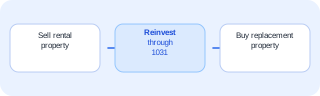
If you sell a rental property with a $400,000 gain, a properly executed 1031 exchange may allow you to defer paying capital gains and depreciation recapture taxes while moving that equity into another investment property.
For investors focused on physician financial freedom, preserving capital can significantly increase long-term compounding.
How Does a 1031 Exchange Work?
A successful exchange follows strict IRS rules. Missing a deadline can invalidate the entire transaction.
The 4-step process
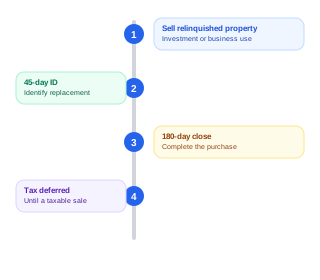
Sell your relinquished property - the property must be held for investment or business purposes.
Use a qualified intermediary (QI) - You cannot take possession of the sale proceeds. A QI holds the funds throughout the exchange.
Identify replacement property within 45 days - The IRS requires written identification of potential replacement properties.
Close within 180 days - The replacement purchase must be completed within 180 calendar days.
These timelines are absolute, making advance planning essential.
Can You Use a 1031 Exchange with a Real Estate Syndication?
This is where many investors become confused.
The short answer
A traditional real estate syndication generally does not qualify for a 1031 exchange.
Why?
Because when you invest in a syndication, you're typically purchasing ownership interests in an LLC, not direct ownership of real property. IRS Section 1031 applies to exchanges of real property, not partnership interests.
Why syndications are different
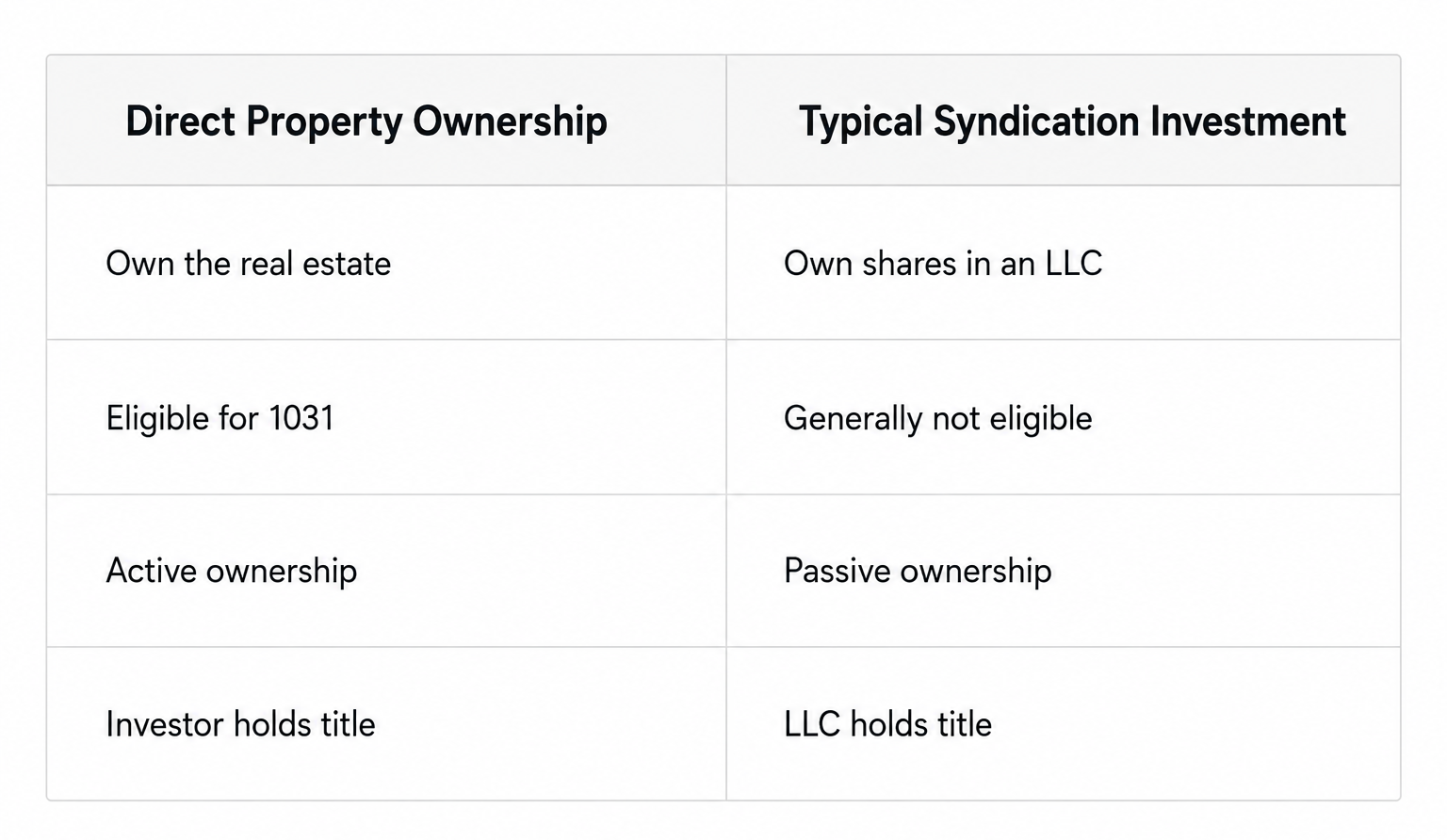
This distinction is one of the most important concepts in real estate syndication explained.
Who Is Eligible for a Syndication?
Most private multifamily syndications are offered under SEC exemptions and are intended for accredited investors.
You may qualify if you meet certain income or net worth thresholds established by securities regulations.
Accredited investors often include:
Physicians and surgeons
Dentists and specialists
Business owners
High-income professionals
Experienced real estate investors
Understanding your qualification is an important part of any accredited investor guide before evaluating private offerings.
Does a 1031 Exchange Eliminate Taxes Forever?
No.
A common misconception is that a 1031 exchange permanently eliminates taxes. It defers them.
Investors often continue exchanging properties over many years, allowing more capital to remain invested. Depending on estate planning strategies and future tax law, long-term outcomes may differ, so it's important to work with qualified tax and legal advisors.
Real Estate vs. Stock Market Returns: Why Investors Compare Both
Many physicians compare real estate vs stock market returns because each offers different strengths.
Neither asset class is universally better. Many financially independent physicians build diversified portfolios that include both public equities and private real estate investments.
Frequently Asked Questions
Can I do a 1031 exchange directly into a syndication?
Generally, no. Most syndications involve purchasing LLC interests rather than direct real estate ownership, making them ineligible for traditional 1031 exchanges.
What passive investment qualifies for a 1031 exchange?
Delaware Statutory Trusts (DSTs) are among the most common passive structures specifically designed to accommodate 1031 exchange investors.
Are multifamily syndications good for beginners?
They can be, provided investors understand the risks, sponsor experience, hold period, and projected business plan. Education is essential before investing.
Why do physicians invest in multifamily real estate?
Many physicians pursue multifamily investing to create passive income, reduce dependence on clinical income, diversify wealth, and build long-term financial freedom.
Final Thoughts
A 1031 exchange remains one of the most valuable tax-deferral tools available to real estate investors, but it is not typically compatible with traditional real estate syndications. Understanding the difference between direct property ownership and LLC ownership can help you avoid costly mistakes and choose the investment structure that matches your goals.
For physicians and accredited investors focused on passive real estate investing, multifamily syndications offer a different advantage: professional management, access to larger institutional-quality assets, and the potential to build long-term wealth without the responsibilities of being a landlord.
If your objective is physician financial freedom, the best strategy is rarely about choosing one tool over another. It's about building a diversified portfolio that aligns with your time, tax situation, and long-term wealth goals.
Daniel Shin, MD