
How Often Do Real Estate Syndications Pay Distributions?
How Often Do Real Estate Syndications Pay Distributions?
Cereus Real Estate |August 07, 2026
For many people exploring passive real estate investing, one of the first questions is simple:
"When do I actually get paid?"
It's a fair question. Whether you're a busy physician, business owner, or accredited investor looking to diversify beyond the stock market, understanding how distributions work is an important part of evaluating any real estate syndication.
The short answer is:
Most real estate syndications distribute income quarterly, although some pay monthly and others may distribute less frequently depending on the investment strategy.
The longer answer is a bit more nuanced - and understanding it can help you become a smarter investor.
Let's take a closer look.
What Is a Real Estate Syndication?
Before discussing distributions, it's helpful to understand how a real estate syndication works.
A syndication allows multiple investors to pool their capital together to purchase larger commercial properties that would be difficult for an individual investor to buy alone.
These properties often include:
Multifamily apartment communities
Medical office buildings
Self-storage facilities
Industrial properties
Build-to-rent communities
Instead of managing tenants, maintenance, or financing yourself, professional operators handle the day-to-day operations while investors participate passively.
This is why many professionals interested in multifamily real estate investing choose syndications—they can gain exposure to institutional-quality real estate without becoming landlords.
How Do Distributions Work?
A distribution is the cash payment investors receive from the property's operating income.
After rent is collected, expenses are paid, and reserves are set aside, the remaining cash flow may be distributed to investors according to the operating agreement.
The exact timing depends on several factors, including:
Property performance
Occupancy levels
Loan requirements
Capital improvement plans
Sponsor strategy
Every investment is different, which is why reading the offering documents carefully is essential.
The Most Common Distribution Schedule
Although every syndication is unique, the industry generally follows a few common payout schedules.
Quarterly Distributions
Quarterly distributions are the most common.
Many commercial real estate investments collect rent monthly but distribute profits every three months.
This approach allows operators to:
Build adequate cash reserves
Smooth out seasonal fluctuations
Account for unexpected maintenance expenses
Provide more consistent investor payments
For many passive investors, quarterly distributions strike a healthy balance between steady cash flow and responsible property management.
Monthly Distributions
Some syndications pay investors every month.
Monthly distributions are more common in stabilized properties with predictable rental income and experienced management teams.
These investments may appeal to investors seeking regular passive income, but monthly distributions are never guaranteed.
Cash flow always depends on property performance.
Annual or Event-Based Distributions
Not every syndication generates immediate cash flow.
Some investments prioritize growth over current income.
For example:
Ground-up developments
Value-add apartment communities undergoing renovations
Large redevelopment projects
During renovation or construction, profits are often reinvested back into the project rather than distributed.
In these cases, investors may receive larger returns when the property is refinanced or sold.
Why Distribution Amounts Can Change
A common misconception is that syndications provide fixed payments like bonds.
In reality, distributions vary because commercial real estate is an operating business.
Several factors can influence payouts.
Occupancy
Higher occupancy generally produces stronger rental income.
Vacancies may temporarily reduce available cash flow.
Renovations
Many value-add properties require capital improvements before rents can increase.
During this period, distributions may be lower while improvements are completed.
Market Conditions
Interest rates, insurance costs, property taxes, and local economic conditions all influence profitability.
Strong operators adjust their business plans to navigate changing markets.
Understanding Preferred Returns
Many syndications include a preferred return.
A preferred return is a target annual return that investors typically receive before the sponsor shares in the profits.
For example:
An offering may advertise an 8% preferred return.
This does not mean investors are guaranteed 8%.
Instead, it establishes the order in which available cash flow is distributed according to the operating agreement.
Understanding preferred returns is an important part of Real Estate Syndication Explained, especially for first-time investors.
Cash Flow Isn't the Only Source of Returns
Many new investors focus only on quarterly distributions.
However, much of the value in passive real estate investing comes from long-term appreciation.
Investors may benefit from:
Rental income
Property appreciation
Loan paydown
Tax advantages
Profit sharing upon sale
Often, the largest returns occur when the property is refinanced or sold after several years.
Why Physicians Often Prefer Passive Real Estate Investing
Doctors face unique financial challenges.
Long work hours leave little time to actively manage rental properties.
Many physicians already have demanding careers and simply want their investments working in the background.
That's one reason passive income for doctors has become increasingly popular.
Rather than fixing maintenance issues or screening tenants, physicians can invest alongside experienced operators while focusing on their medical practice and personal lives.
For many investors, this approach supports a broader goal of physician financial freedom—building wealth without adding another full-time job.
Real Estate vs. Stock Market Returns
Many investors compare commercial real estate with public equities.
While stocks offer liquidity, they can also experience significant short-term volatility.
Commercial real estate often provides different benefits, including:
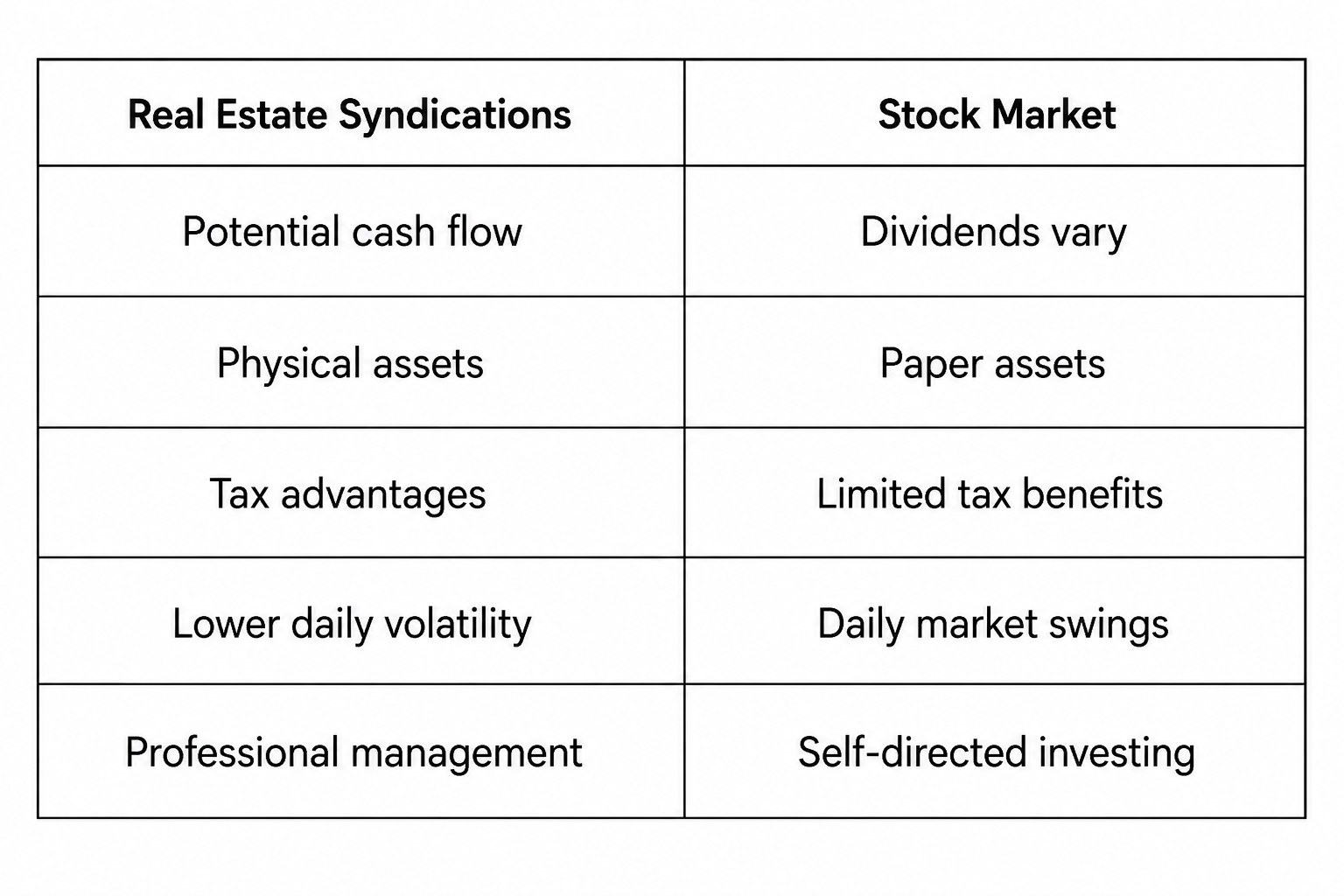
Every investment carries risk, but understanding real estate vs. stock market returns helps investors build a diversified portfolio rather than relying on a single asset class.
Multifamily Investing for Beginners
If you're new to commercial real estate, multifamily properties are often one of the easiest places to begin.
Why?
Housing remains an essential need regardless of market cycles.
Large apartment communities also benefit from diversified income because rent comes from many residents rather than a single tenant.
This makes multifamily investing for beginners an attractive entry point into passive commercial real estate.
How Accredited Investors Build Wealth
One of the biggest advantages available to accredited investors is access to private investment opportunities.
Unlike publicly traded REITs or traditional mutual funds, private syndications can offer:
Access to institutional-quality properties
Professional asset management
Potential tax benefits
Diversification beyond public markets
Long-term wealth creation
Understanding how accredited investors build wealth often begins with learning how private real estate investments fit within a broader financial plan.
What Should Investors Ask Before Investing?
Before participating in any syndication, ask questions such as:
How often are distributions expected?
Is there a preferred return?
What assumptions support projected cash flow?
How much cash is being reserved?
What is the expected hold period?
How are profits distributed upon sale?
What risks could affect distributions?
Transparent communication from the sponsor is one of the strongest indicators of a well-managed investment.
Final Thoughts
So, how often do real estate syndications pay distributions?
In most cases, investors receive payments quarterly, although monthly and annual schedules are also common depending on the property's strategy.
More importantly, successful passive investing isn't just about how frequently distributions arrive. It's about investing in quality assets, partnering with experienced operators, and maintaining a long-term perspective.
At Cereus Real Estate, we believe passive investing should be built on education, transparency, and disciplined investment strategies. Whether you're exploring real estate syndication explained for the first time or you're an experienced accredited investor seeking opportunities in multifamily real estate investing, understanding how distributions work is an important step toward making informed investment decisions.
Frequently Asked Questions (FAQs)
Do real estate syndications pay monthly?
Some do, but quarterly distributions are more common. Payment schedules vary based on the investment strategy and property performance.
Are syndication distributions guaranteed?
No. Distributions depend on the property's financial performance and are never guaranteed.
What is a preferred return?
A preferred return is the priority return investors may receive before the sponsor participates in profits. It is a distribution preference, not a guarantee.
How long do syndications usually last?
Many commercial real estate syndications have hold periods ranging from 3 to 7 years, depending on the business plan.
Are real estate syndications good for physicians?
Many physicians choose syndications because they offer exposure to commercial real estate without requiring active property management, making them a popular passive income strategy for doctors.
Daniel Shin, MD