
Class A vs. Class B vs. Class C Multifamily Properties: Understanding the Differences Before You Invest
Class A vs. Class B vs. Class C Multifamily Properties: Understanding the Differences Before You Invest
Cereus Real Estate |August 05, 2026
Walk into any commercial real estate conference, investor meetup, or multifamily webinar, and you'll hear the same phrases repeated over and over:
"We're targeting Class B assets."
"This is a value-add Class C opportunity."
"Class A properties are trading at historically low cap rates."
For someone new to multifamily real estate investing, these classifications can sound like insider terminology. Many investors assume the labels simply refer to whether an apartment building looks luxurious or outdated. While appearance plays a role, property classifications represent much more than curb appeal.
The difference between Class A, Class B, and Class C multifamily properties affects nearly every aspect of an investment. It influences the type of tenants a property attracts, expected rental income, renovation costs, appreciation potential, financing options, and overall investment risk.
At Cereus Real Estate, we believe informed investors make better investment decisions. Whether you're investing directly or participating in passive real estate investing through professionally managed opportunities, understanding these property classes helps you evaluate deals with greater confidence.
This guide explains what each classification means, why it matters, and how experienced investors use these distinctions to build diversified real estate portfolios.
Why Multifamily Property Classes Matter
Property classifications are not assigned by any government agency or national organization. Instead, they serve as an industry-wide framework that helps brokers, lenders, investors, and property managers communicate the overall quality and positioning of an apartment community.
Rather than focusing on a single factor like age, experienced investors evaluate several characteristics simultaneously, including:
Construction quality
Physical condition
Neighborhood desirability
Local economic strength
Rental demand
Tenant demographics
Amenity offerings
Capital improvement requirements
Long-term appreciation potential
Think of these classifications as a shortcut. Instead of reviewing hundreds of details, investors can quickly develop an initial understanding of a property's strengths, challenges, and investment profile.
However, it's important to remember that these labels are relative to each market.
A recently renovated apartment community in a growing suburban market might qualify as a Class A asset locally, while a similar property in a major metropolitan area with newer luxury developments could be viewed as Class B.
This is why experienced multifamily investors evaluate each property within the context of its local market rather than relying solely on its classification.
Understanding Class A Multifamily Properties
When most people imagine modern apartment living, they're picturing a Class A multifamily property.
These communities are typically built within the last decade or have undergone substantial renovations that bring them close to new construction standards.
They're usually located in desirable neighborhoods with strong employment opportunities, quality schools, convenient shopping, and easy access to transportation.
Walking through a Class A community, you'll often find amenities designed to enhance residents' lifestyles rather than simply provide housing.
Common features include:
Resort-style swimming pools
Modern fitness centers
Package lockers
Coworking spaces
Clubhouses
Outdoor entertainment areas
Smart-home technology
Energy-efficient appliances
High-end interior finishes
The target residents are often professionals, healthcare workers, executives, and families willing to pay premium rents for convenience, quality, and location.
Because these properties attract financially stable tenants, vacancy rates often remain relatively low, especially in markets experiencing steady population and job growth.
The Investment Perspective
For many investors, Class A properties represent stability.
Newer buildings generally require fewer immediate repairs, major systems are still within their useful lifespan, and maintenance expenses tend to be more predictable during the early years of ownership.
This stability often translates into consistent occupancy and dependable rental income.
However, premium quality comes with premium pricing.
Since demand for Class A communities is typically high, investors frequently pay more per unit than they would for older apartment properties. Higher acquisition costs usually result in lower capitalization rates and more modest cash-on-cash returns.
In other words, investors often accept lower immediate income in exchange for reduced operational risk and long-term appreciation potential.
Advantages of Class A Multifamily Properties
Investors are often attracted to Class A communities because they offer several meaningful benefits.
Lower Maintenance Costs
Since most building systems are newer, unexpected capital expenditures are generally less frequent during the first several years of ownership.
Strong Tenant Demand
Quality housing in desirable locations consistently attracts renters, helping owners maintain healthy occupancy rates.
Attractive Financing Options
Lenders often view Class A assets as lower-risk investments, making financing more competitive under favorable market conditions.
Long-Term Appreciation
Properties located in expanding markets with growing employment and limited housing supply may experience meaningful appreciation over time.
Potential Challenges
Although Class A properties are considered relatively stable investments, they are not without risk.
Because acquisition prices are higher, investors may experience lower initial cash flow compared to value-add opportunities.
Competition can also be intense. Institutional investors, private equity firms, and large investment groups frequently pursue these premium assets, driving prices upward.
Additionally, during economic slowdowns, luxury apartment communities may experience increased pressure as some renters seek more affordable housing options.
For these reasons, experienced investors evaluate local market fundamentals not just the property's appearance before making investment decisions.
Is Class A Right for Every Investor?
Not necessarily.
Some investors prioritize stability and long-term appreciation. Others prefer opportunities where strategic renovations can significantly increase rental income and property value.
Neither approach is inherently better.
The right investment depends on your financial goals, risk tolerance, investment timeline, and overall portfolio strategy.
In the next section, we'll explore why many experienced multifamily investors view Class B properties as one of the most attractive opportunities in today's market - and why they often strike a compelling balance between stability, cash flow, and value creation.
Class B Multifamily Properties: Where Stability Meets Opportunity
If Class A properties are known for their luxury appeal, Class B multifamily properties are often recognized for their ability to create value. In fact, many experienced real estate investors consider Class B assets to offer one of the best combinations of cash flow, appreciation potential, and manageable risk.
Class B communities are generally between 15 and 35 years old, although age alone doesn't determine the classification. Many of these properties have solid construction, desirable floor plans, and established tenant bases but may lack the modern finishes and amenities found in newer developments.
Instead of requiring a complete redevelopment, these communities often benefit from strategic upgrades that improve both resident satisfaction and rental income.
Typical improvements include:
Renovating kitchens and bathrooms
Installing new flooring and lighting
Replacing outdated appliances
Refreshing exterior paint and landscaping
Upgrading community amenities
Improving common areas and security features
These renovations can significantly increase a property's market value while remaining far less expensive than developing a new apartment community from the ground up.
Why Investors Are Drawn to Class B Properties
One of the biggest advantages of Class B assets is their balance between stability and growth.
Unlike luxury properties that already command premium rents, Class B communities often have room to increase rental income after thoughtful renovations. This strategy commonly referred to as value-add investing allows investors to improve both the resident experience and the property's financial performance.
Additional benefits include:
Higher Cash Flow Potential
Because Class B properties are usually purchased at lower prices than comparable Class A assets, investors often enjoy stronger cash flow while still benefiting from steady tenant demand.
Opportunity for Appreciation
Property improvements, better management practices, and rising rents can increase a property's overall value over time, creating equity growth in addition to ongoing rental income.
Consistent Demand
Many renters are looking for quality housing at a more affordable price than luxury apartments. Class B communities often serve this large segment of the rental market, helping maintain healthy occupancy levels.
Lower Acquisition Costs
Compared with newly built communities, Class B properties generally require less capital to acquire while still offering attractive long-term investment potential.
Challenges of Investing in Class B Properties
Although Class B investments can be highly rewarding, they also require thoughtful execution.
Renovation projects must be carefully planned and budgeted. Poor construction management, inaccurate cost estimates, or extended renovation timelines can reduce projected returns.
Successful Class B investing depends on experienced property management, disciplined capital planning, and a clear understanding of local market demand.
At Cereus Real Estate, every opportunity is evaluated through a disciplined investment process that considers renovation costs, rental demand, neighborhood trends, and long-term appreciation potential before capital is deployed.
Class C Multifamily Properties: Higher Risk with Greater Operational Complexity
Class C multifamily properties typically represent the oldest apartment communities within a market. Many were built several decades ago and have received only limited updates over the years.
These properties generally offer lower rental rates, making them attractive to cost-conscious renters, but they also require significantly more hands-on management.
Common characteristics include:
Aging plumbing and electrical systems
Older roofs and HVAC equipment
Outdated unit interiors
Deferred maintenance
Limited community amenities
Higher ongoing repair costs
While these properties may be acquired at lower purchase prices, investors should expect additional capital expenditures to modernize the community and maintain long-term competitiveness.
Where Class C Properties Create Value
For experienced operators, Class C communities can present meaningful opportunities.
Strategic improvements such as replacing major building systems, renovating apartment interiors, improving landscaping, and enhancing security can transform an underperforming property into a more desirable place to live.
When renovations are executed successfully, owners may benefit from:
Increased rental income
Higher occupancy rates
Improved resident retention
Greater property value
Enhanced long-term returns
However, these outcomes require careful planning, experienced management teams, and sufficient capital reserves.
Challenges of Class C Investments
Compared to Class A and Class B properties, Class C assets generally involve greater operational risk.
Investors should be prepared for:
Larger maintenance budgets
Higher renovation expenses
More frequent repairs
Increased management oversight
Greater exposure to economic fluctuations
Longer timelines to complete repositioning projects
Because of these factors, Class C investing is often better suited for experienced sponsors with established operational systems rather than first-time investors purchasing properties independently.
Comparing Class A, Class B, and Class C Multifamily Properties
While every investment should be evaluated individually, understanding how the three property classes generally compare can help investors align opportunities with their financial goals.
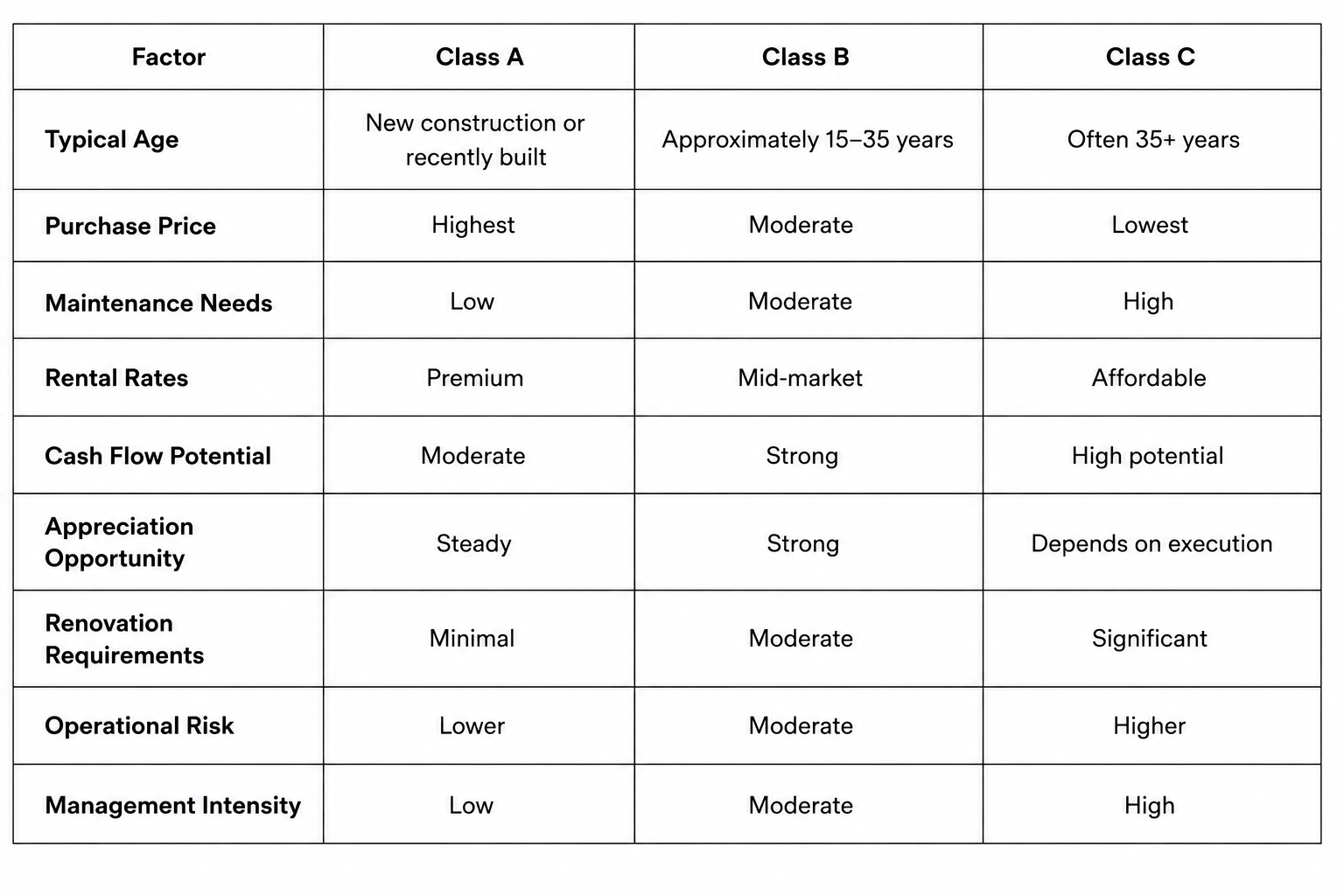
Each property class serves a different purpose within a diversified real estate portfolio.
Investors seeking predictable performance may lean toward Class A assets. Those looking for a balance between income and appreciation often favor Class B opportunities. Investors comfortable with larger renovation projects and greater operational involvement may pursue carefully selected Class C investments.
Rather than asking which class is "best," experienced investors ask a more important question:
Which investment best aligns with my financial objectives, risk tolerance, and long-term wealth-building strategy?
There is no universally 'best' property class. The most appropriate investment is one that aligns with your goals and is backed by experienced operators. Passive investors benefit from partnering with sponsors that emphasize disciplined underwriting, thoughtful asset management, and long-term value creation.
Frequently Asked Questions
Is Class A always the best investment?
No. It offers stability but not necessarily the highest returns.
Why do investors like Class B properties?
They often combine steady cash flow with appreciation through renovations.
Are Class C properties risky?
They require experienced management and larger capital reserves.
What is value-add investing?
Improving a property to increase income and value.
Can physicians invest passively?
Yes, accredited investors can participate through professionally managed syndications and funds.
What does Cereus Real Estate look for?
Strong markets, disciplined underwriting, and long-term value creation.
Which property class has the highest cash flow?
It depends on the market, but Class B and well-managed Class C properties may provide stronger cash flow.
Should beginners buy Class C properties?
Many first-time passive investors prefer experienced sponsors rather than managing complex assets themselves.
Daniel Shin, MD