506(b) vs. 506(c) Offerings: What’s the Difference for Investors?
506(b) vs. 506(c) Offerings: What’s the Difference for Investors?
Cereus Real Estate |August 11, 2026
If you have started exploring private real estate investments, you have probably come across terms like 506(b) and 506(c).
At first glance, they can seem like technical securities-law terminology that has little to do with your actual investment decision. But these two structures can affect who can invest, how an offering can be marketed, and how an investor's accredited status is handled.
For physicians, high-income professionals, NRIs, and other investors exploring passive real estate investing, understanding the difference can make it easier to evaluate opportunities with confidence.
Both 506(b) and 506(c) offerings fall under Regulation D of the Securities Act and can be used for private investments such as multifamily real estate investing and real estate syndications. However, the rules surrounding solicitation and investor eligibility are different.
So, what exactly separates them?
Let's break it down.
What Is a 506(b) Offering?
Rule 506(b) is commonly associated with private placements where the sponsor does not publicly advertise the securities offering.
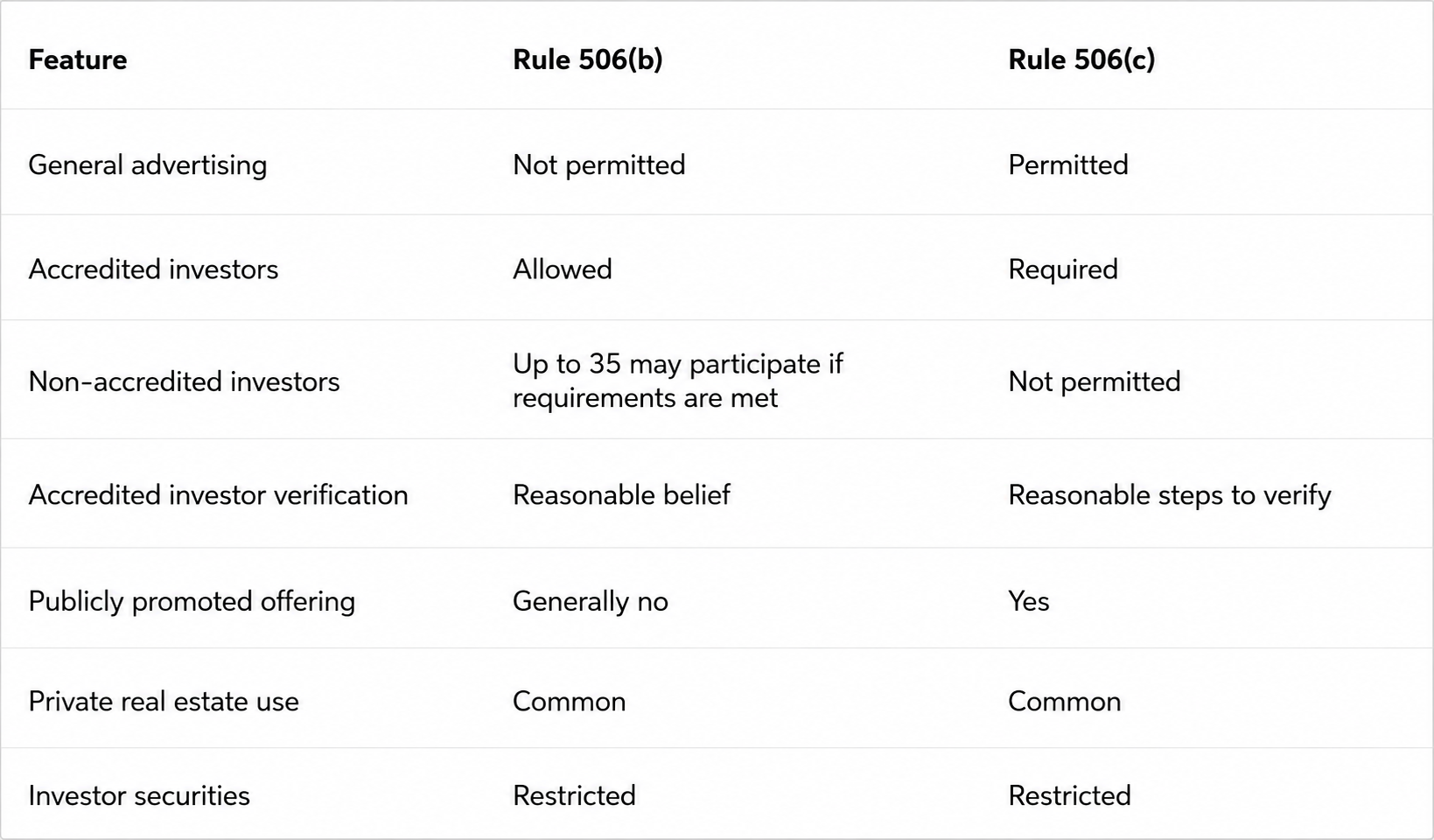
Under Rule 506(b), a sponsor can raise an unlimited amount of capital and sell securities to an unlimited number of accredited investors. The offering can also include up to 35 non-accredited investors, provided those investors meet additional requirements.
The important point is that general solicitation is not permitted.
That means a sponsor generally cannot publicly advertise a specific securities offering through unrestricted websites, public advertisements, or similar broad marketing channels.
For investors, this can mean that 506(b) opportunities are often introduced through an existing relationship with the sponsor, investment professional, or another person involved in the offering.
What does this mean for investors?
A 506(b) offering may be a good fit for investors who already have a relationship with a sponsor or investment group and are comfortable evaluating private investment opportunities through a more relationship-driven process.
It also allows a limited number of non-accredited investors to participate, although additional disclosure and investor requirements apply to those investors.
What Is a 506(c) Offering?
Rule 506(c) was created to give sponsors more flexibility when marketing private offerings.
Unlike 506(b), general solicitation and advertising are permitted under Rule 506(c). A sponsor can publicly promote an offering, including through websites, social media, webinars, email marketing, and other advertising channels.
But there is an important trade-off.
Every purchaser in a 506(c) offering must be an accredited investor, and the sponsor must take reasonable steps to verify that status.
This is different from simply asking an investor to check a box confirming that they are accredited.
The SEC describes Rule 506(c) verification as a principles-based process. Depending on the circumstances, verification can involve reviewing financial information or using other reasonable methods appropriate to the investor and offering.
506(b) vs. 506(c): The Key Differences
The Biggest Difference: How the Offering Can Be Marketed
For many investors, the most noticeable difference between 506(b) and 506(c) is how the sponsor is allowed to find investors.
506(b): Relationship-Based
A 506(b) offering cannot use general solicitation.
Imagine a physician has worked with a real estate investment group for several years. The sponsor contacts the physician about a new multifamily opportunity.
That type of relationship-driven process can fit naturally within a 506(b) structure, assuming the offering otherwise satisfies the applicable requirements.
The offering isn't being publicly advertised to everyone.
Instead, the sponsor is communicating with potential investors through established relationships.
506(c): Publicly Marketed
Now imagine a real estate sponsor publishes an investment opportunity on its website and promotes educational content about the offering through LinkedIn, webinars, email campaigns, or other public channels.
That type of broad marketing can be permitted under 506(c), provided the offering satisfies the applicable requirements, including limiting purchasers to accredited investors and taking reasonable steps to verify their status.
This is one reason you may see more private investment firms openly discussing their offerings online today.
What Is an Accredited Investor?
The term "accredited investor" comes up frequently when discussing private real estate.
The SEC allows individuals to qualify through several pathways.
One common pathway is based on income. An individual may qualify if they earned more than $200,000 in each of the previous two years and reasonably expect to reach that level in the current year. The threshold is $300,000 with a spouse or partner.
Another common pathway is net worth.
An individual may qualify with a net worth exceeding $1 million, either individually or jointly with a spouse or partner, excluding the value of the person's primary residence.
There are also professional and entity-based qualification categories.
This is why an accredited investor guide should go beyond simply asking whether someone earns a high salary. The rules contain multiple qualification pathways.
And because eligibility can depend on specific facts and circumstances, investors should review their situation carefully with qualified legal, tax, or financial professionals when appropriate.
Why Does Accredited Investor Verification Matter?
This is where 506(b) and 506(c) become particularly different.
Under 506(b), the sponsor generally needs a reasonable belief that an investor qualifies as accredited if the investor is purchasing as an accredited investor.
Under 506(c), the sponsor must take reasonable steps to verify accredited investor status.
The SEC's verification framework is flexible. The appropriate method can depend on the investor, the information available, how the investor was approached, and the terms of the offering.
In other words, 506(c) doesn't simply mean:
"Are you accredited?"
It requires the sponsor to take appropriate steps to verify the answer.
How Does This Apply to Real Estate Syndication?
This distinction matters because many private real estate investments are structured as real estate syndications.
In a typical syndication, multiple investors contribute capital toward a larger real estate investment. A sponsor or operating partner generally handles the acquisition, financing, management, and execution of the business plan.
For example, a multifamily syndication might acquire an apartment community and pursue improvements such as:
Renovating units
Improving property operations
Increasing occupancy
Managing expenses
Enhancing amenities
Repositioning the property
Refinancing or selling the asset
The investors aren't necessarily managing the apartment community themselves.
That's one reason syndications are often considered a form of passive real estate investing.
Instead of purchasing and operating an apartment building independently, an investor can participate alongside other investors while the sponsor manages the day-to-day execution.
Real Estate Syndication Explained: Where 506(b) and 506(c) Fit
When people search for Real Estate Syndication Explained, one of the first concepts worth understanding is that the syndication structure and the securities exemption are two different things.
A syndication describes how the investment is organized.
Rule 506(b) or 506(c) describes the federal securities-law exemption being used for the offering.
For example, a multifamily investment could potentially be structured as:
Multifamily property → Real estate syndication → Regulation D → 506(b) or 506(c)
The specific structure depends on the offering and its legal documentation.
That's why investors shouldn't assume that every syndication follows the same rules.
506(b) vs. 506(c) for Multifamily Real Estate Investing
For investors interested in multifamily real estate investing, both structures can provide access to private real estate opportunities.
The bigger question isn't necessarily:
"Is 506(b) better than 506(c)?"
Instead, ask:
"Does this particular investment make sense for me?"
The securities exemption is only one part of the evaluation.
Investors should also understand:
What property is being purchased?
Where is the property located?
What is the investment strategy?
How much equity is being raised?
What are the projected returns?
What assumptions support those projections?
What are the fees?
How long is the expected hold period?
What risks could affect the investment?
How does the sponsor plan to create value?
What happens if the property underperforms?
Those questions often matter much more to your long-term outcome than whether the offering happens to be 506(b) or 506(c).
What About Passive Income for Doctors?
Physicians often have a unique investment challenge.
They may have a high income but very little free time.
Between patient care, administrative responsibilities, family commitments, and continuing education, actively managing rental properties can become another job.
That's where passive income for doctors becomes an increasingly relevant topic.
A physician doesn't necessarily need to become a landlord to gain real estate exposure.
Through a properly structured investment, a physician may be able to participate in real estate while leaving property-level management to an experienced sponsor.
That doesn't mean passive real estate is risk-free or guaranteed. It simply means the investor's role can be substantially different from that of an active property owner.
For doctors pursuing physician financial freedom, that distinction can be meaningful.
The goal isn't necessarily to accumulate more responsibilities.
It can be about building an investment strategy that works alongside an already demanding career.
Physician Financial Freedom Isn't Just About Earning More
For many physicians, the traditional financial playbook focuses heavily on income.
Earn more.
Save more.
Invest more.
Repeat.
But financial independence can also involve creating assets that don't require the investor to exchange additional hours of work for additional income.
That is one reason physicians explore passive income strategies for doctors.
Real estate is one potential component of that strategy.
Private multifamily investments, for example, may provide exposure to rental housing, potential cash flow, and potential long-term appreciation. However, actual results vary, and private investments can involve significant risks, including illiquidity and loss of principal.
The right investment depends on the individual's goals, risk tolerance, liquidity needs, and overall financial situation.
Doctor Financial Independence India and NRI Investors
The conversation can become even more complicated for physicians and investors living outside the United States.
Searches such as Doctor Financial Independence India and Real Estate Wealth Building NRI reflect growing interest among internationally based professionals in U.S. investment opportunities.
For an NRI physician considering a U.S. real estate investment, however, there are additional considerations beyond whether an offering is 506(b) or 506(c).
These may include:
U.S. securities regulations
Investor eligibility
Tax reporting
Currency considerations
Cross-border tax implications
Ownership structure
Estate planning
Investment liquidity
The key takeaway is simple: being an accredited investor does not automatically make every investment appropriate for an NRI.
Cross-border investors should consider speaking with professionals who understand both U.S. and applicable home-country tax and legal requirements before investing.
Multifamily Investing for Beginners: What Should You Look For?
If you're new to multifamily investing for beginners, don't start with projected returns.
Start with the underlying investment.
Here are several questions worth asking.
1. What am I actually buying?
Understand the property, location, unit count, tenant base, and business plan.
2. Who is operating the investment?
Look at the sponsor's experience, track record, communication practices, and previous projects.
3. How is the deal financed?
Debt can increase purchasing power, but it can also increase risk.
4. Where do projected returns come from?
Ask whether returns depend primarily on rental growth, operational improvements, property appreciation, refinancing, or a combination.
5. How long could my money be invested?
Private real estate is generally not as liquid as publicly traded investments.
6. What could go wrong?
A strong investment analysis doesn't only explain the upside.
It should also address vacancy, rising expenses, interest rates, insurance costs, unexpected capital expenditures, slower rent growth, and other risks.
How Accredited Investors Build Wealth
The question of how accredited investors build wealth is bigger than simply finding private investments.
Accredited status provides access to certain investment opportunities, but access doesn't automatically equal success.
Building long-term wealth typically involves several principles:
Diversification
Avoid relying entirely on one asset or investment.
Time horizon
Understand how long your capital may be committed.
Due diligence
Review the sponsor, property, financial assumptions, debt, fees, and risks.
Tax awareness
Understand how the investment may affect your tax situation.
Risk management
Don't invest money that you may need for short-term expenses.
Consistency
Wealth building is usually a process rather than a single investment decision.
For physicians and other high-income professionals, private real estate may become one piece of a broader wealth strategy rather than the entire strategy.
506(b) vs. 506(c): Which One Is Better?
There isn't a universal winner.
506(b) may be attractive when a sponsor prefers a relationship-driven fundraising process and potentially wants the flexibility to include a limited number of qualifying non-accredited investors.
506(c) may be attractive when a sponsor wants to publicly market an offering and reach accredited investors more broadly.
From an investor's perspective, neither designation should automatically be interpreted as a sign that an investment is better or safer.
A 506(c) offering isn't automatically better because it is publicly advertised.
A 506(b) offering isn't automatically safer because it is privately marketed.
The exemption tells you about how the offering is being conducted under securities law. It doesn't tell you whether the underlying property is a good investment.
What Should Investors Ask Before Investing?
Before committing capital to a private real estate offering, consider asking:
1. What Regulation D exemption is being used?
Is it 506(b) or 506(c)?
2. Am I eligible to invest?
If it is a 506(c) offering, understand how accredited status will be verified.
3. What exactly am I investing in?
Understand the entity, property, ownership structure, and investment strategy.
4. What are the risks?
Don't focus only on projected returns.
5. What are the fees?
Understand acquisition fees, asset management fees, disposition fees, financing-related fees, and other expenses.
6. When can I expect my capital back?
Private investments can be illiquid.
7. How experienced is the sponsor?
Track record matters, but past performance does not guarantee future results.
8. Does this investment fit my overall portfolio?
Even an attractive deal may not be appropriate if it creates too much concentration or illiquidity.
Frequently Asked Questions
Is 506(b) or 506(c) better for investors?
Neither is inherently better. The main differences involve marketing, investor eligibility, and accredited investor verification. Investors should evaluate the specific investment rather than choosing solely based on the exemption.
Can non-accredited investors invest in a 506(b) offering?
Yes. A 506(b) offering can include up to 35 non-accredited investors who meet additional requirements.
Can non-accredited investors invest in a 506(c) offering?
No. Rule 506(c) requires all purchasers to be accredited investors, and the issuer must take reasonable steps to verify their accredited status.
Can a 506(c) offering be advertised publicly?
Yes. General solicitation and advertising are permitted under Rule 506(c), subject to the requirements of the exemption.
Does 506(c) mean the investment is safer?
No. 506(c) describes the securities-law structure of the offering. It does not guarantee investment performance, property quality, or investor returns.
Is multifamily real estate considered passive investing?
It can be when an investor participates through a syndication or other structure where a sponsor handles the property's operations. However, investors should understand that "passive" does not mean risk-free or guaranteed.
Can physicians invest in real estate syndications?
Physicians can potentially participate in real estate syndications if they meet the eligibility requirements of the particular offering and the investment is appropriate for their circumstances.
Can NRI physicians invest in U.S. real estate?
Potentially, yes, but NRI investors should consider U.S. securities, tax, and cross-border implications before investing. Professional advice may be appropriate depending on the investor's circumstances.
Final Thoughts
The difference between 506(b) and 506(c) may seem like a technical detail, but it is worth understanding if you're considering private real estate.
At its core, the distinction comes down to two major questions:
How can the offering be marketed?
And:
Who can invest, and how is accredited status handled?
506(b) generally relies on private, non-public solicitation and can accommodate a limited number of qualifying non-accredited investors.
506(c) allows general solicitation, but all purchasers must be accredited investors and the sponsor must take reasonable steps to verify that status.
For investors exploring passive real estate investing, real estate syndication, and multifamily real estate investing, understanding these differences is a useful starting point.
But don't stop there.
The more important work is evaluating the property, sponsor, investment strategy, financing, projected returns, fees, timeline, and risks.
For physicians pursuing physician financial freedom and for investors focused on long-term wealth creation, the goal isn't simply to find an investment that looks attractive.
It's to build a thoughtful strategy around your capital, your goals, and your future.
Cereus Real Estate focuses on helping investors explore opportunities in private real estate, including multifamily investments, with a long-term approach to real estate wealth building.
This article is for educational purposes only and is not legal, tax, or investment advice. Private real estate investments involve risk, including possible loss of principal and limited liquidity. Investors should review the offering documents and consult their own qualified professional advisers before making an investment decision.
Daniel Shin, MD