
What Is a Capital Call in Real Estate Syndication? | Cereus Real Estate
What Is a Capital Call in Real Estate Syndication?
Cereus Real Estate | September 28, 2026
Everything physicians and passive investors should know before investing in a syndication.
A capital call is one of the most misunderstood terms in passive real estate investing. Knowing how it works can help you evaluate syndications more confidently.
Many physicians are drawn to real estate syndications because they offer the opportunity to build passive wealth without becoming a landlord. Instead of managing tenants, repairs, or leasing, investors contribute capital while experienced operators acquire and manage large multifamily or commercial properties.
But one term often creates uncertainty for new investors: capital call.
Does it mean the investment is failing? Is it mandatory? Can you lose your ownership if you do not participate?
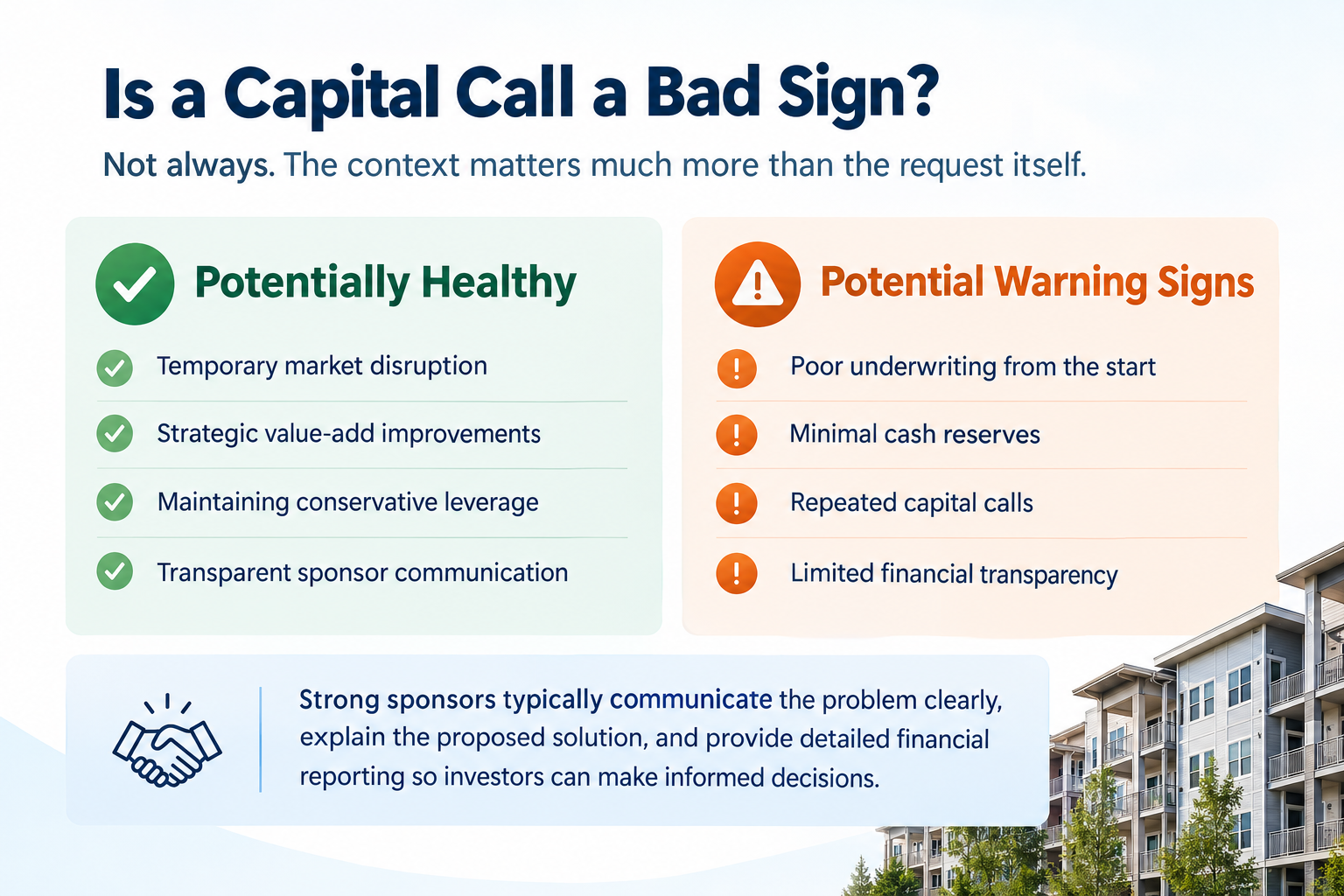
The short answer is: not necessarily. A capital call is simply a request for additional capital from existing investors, and whether it is a sign of prudent management or financial distress depends on the circumstances.
In this guide, we will explain what a capital call is, why it happens, how it affects passive investors, and what questions you should ask before investing in any real estate syndication.
What Is a Capital Call?
A capital call is a formal request by the syndication sponsor for investors to contribute additional money after the initial investment has already been made.
In most real estate syndications, investors commit capital at closing. That money is used to purchase the property, fund renovations, create operating reserves, and cover acquisition costs.
However, unexpected situations may require additional funding later in the investment. Rather than immediately taking on expensive debt or selling the property, the sponsor may ask existing investors to provide additional equity.
Think of it as an emergency or strategic funding round within the same investment not a brand-new deal.

How Does a Capital Call Work?
Every syndication is governed by legal documents primarily the Private Placement Memorandum (PPM) and the Operating Agreement. These documents outline whether capital calls are allowed and how they are handled.
A typical process looks like this:
An unexpected financial need arises.
The sponsor notifies investors with details.
Investors receive the amount requested and deadline.
Investors choose whether to participate (depending on the agreement).
Funds are deployed to stabilize or improve the property.
Some syndications make participation mandatory, while many offer it as an optional opportunity. The rules vary from deal to deal, which is why reading the operating agreement is essential before investing.
Why Do Capital Calls Happen?
Not all capital calls are negative. Some are defensive, while others are designed to create additional value for investors.
1. Unexpected operating expenses
Insurance premiums, property taxes, or maintenance costs may increase more than projected. Natural disasters or major repairs can also create temporary funding needs.
2. Higher vacancy or slower leasing
If rental income drops because occupancy declines or new apartment supply temporarily increases, additional reserves may help the property maintain operations until the market recovers.
3. Renovation opportunities
Sometimes a sponsor identifies an opportunity to accelerate renovations that could significantly increase rents and long-term property value.
4. Protecting investor equity
Rather than accepting unfavorable refinancing terms during a challenging lending environment, raising additional equity may preserve more long-term value for investors.
What Happens If You Do Not Participate?
This depends entirely on the syndication's legal structure.
Common outcomes include:
Scenario | Possible Outcome |
|---|---|
Optional capital call | Your ownership remains unchanged |
Pro-rata participation | Investors maintain ownership percentage by contributing proportionally |
Dilution provision | Non-participating investors may own a smaller percentage afterward |
Preferred equity structure | New capital may receive different return priorities |
Before investing, ask the sponsor exactly how non-participation is handled. There is no universal rule across syndications.
Questions Every Passive Investor Should Ask
Before committing capital, ask these five questions:
Does the operating agreement allow capital calls?
How much cash reserve is being raised at closing?
What assumptions were used for vacancy and expenses?
What happens if I choose not to participate?
Has the sponsor completed previous deals without repeated capital calls?
These questions often reveal more about the quality of the investment than projected returns alone.
How Conservative Sponsors Reduce Capital Call Risk
Experienced real estate operators cannot eliminate risk but they can reduce the likelihood of needing additional investor capital.
Many conservative sponsors focus on:
Raising adequate operating reserves at acquisition
Using realistic rent growth assumptions instead of optimistic projections
Avoiding excessive leverage
Stress-testing deals against higher interest rates and vacancy
Providing consistent investor reporting throughout the hold period
This disciplined approach is especially valuable for physicians and busy professionals seeking predictable passive investments rather than speculative returns.
Final Thoughts
A capital call is not automatically a red flag. It is a financing tool that can either protect investor value or expose weaknesses in an investment's original underwriting. The difference lies in the sponsor's planning, transparency, reserves, and decision - making.
For passive investors, the goal is not to find deals that promise perfection - it is to partner with sponsors who prepare for uncertainty before it arrives.
Understanding how capital calls work allows you to evaluate syndications with greater confidence and make more informed long-term investment decisions.
Frequently Asked Questions
Are capital calls common in real estate syndications?
They are relatively uncommon in well-capitalized syndications but became more frequent during periods of rising interest rates, increased insurance costs, and temporary market disruption.
Is participation always required?
No. Some syndications make capital calls optional, while others include mandatory or dilution provisions. Always review the operating agreement.
Does a capital call reduce my returns?
It can. Contributing additional capital may increase your investment basis, while declining participation could reduce future ownership if dilution provisions apply.
Can a sponsor issue unlimited capital calls?
No. The sponsor's authority is limited by the legal documents governing the syndication. Those documents define when and how capital calls may occur.
How can I reduce my risk as an investor?
Invest with experienced sponsors who maintain strong reserves, underwrite conservatively, communicate transparently, and have a demonstrated track record of managing market cycles.
Daniel Shin, MD